
By Okey IBEKE
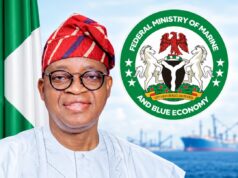
At the 2026 Day of the Seafarer celebration held in Lagos on Thursday, June 25, the Minister of Marine and Blue Economy, Adegboyega Oyetola, once again reaffirmed the Federal Government’s commitment to establishing a national shipping carrier. According to the minister, the project has reached its final stages and will be implemented through a Public-Private Partnership (PPP) arrangement.
He explained that the proposed carrier is intended to reduce Nigeria’s dependence on foreign shipping companies, curb capital flight arising from freight payments, strengthen indigenous shipping capacity, create employment opportunities for Nigerian seafarers and provide much-needed sea-time training for cadets seeking international certification.
This was not the first time such assurances have been given. Only a few months earlier, during the Ministry’s stakeholders’ engagement and performance retreat in Lagos, Oyetola disclosed that the government had made significant progress toward re-establishing a national shipping carrier and had attracted expressions of interest from two global maritime giants—AD Ports Group and DP World of the United Arab Emirates—to collaborate on the initiative.
Since the creation of the Ministry of Marine and Blue Economy in 2023, the establishment of a national carrier has remained one of its flagship policy objectives. The minister has consistently highlighted its strategic importance at virtually every major maritime event. While few stakeholders dispute the enormous benefits of restoring Nigeria’s presence in international shipping, repeated announcements without corresponding public milestones are beginning to generate more questions than excitement.
The need for a national carrier cannot be overemphasized. Since the liquidation of the Nigerian National Shipping Line (NNSL) in 1995 following years of financial distress, ageing vessels, mounting debts and operational inefficiencies, Nigeria has remained almost entirely dependent on foreign shipping companies for the movement of its international trade. This dependence has contributed to enormous capital flight through freight payments, limited opportunities for Nigerian seafarers, weakened indigenous shipping capacity and reduced the country’s influence in global maritime commerce.
For nearly three decades, successive administrations have promised to restore Nigeria’s presence on international waters. Every government has acknowledged the strategic importance of a national carrier, yet each initiative has either stalled or quietly faded away.
The administration of President Bola Ahmed Tinubu now appears determined to revive the project. However, while government has repeatedly spoken of discussions with AD Ports Group and DP World, neither the ownership structure nor the commercial framework of the proposed company has been publicly disclosed. Expressions of interest by prospective partners are encouraging, but they are not substitutes for a clearly articulated implementation strategy.
Nigerians still remember the previous attempt under the administration of former President Muhammadu Buhari. That initiative generated considerable optimism after government unveiled plans to establish a new national carrier through a Special Purpose Vehicle involving foreign technical partners. However, the project became mired in controversy over ownership structure, transparency, governance arrangements and the perceived marginalization of indigenous shipowners. Industry associations, labour unions and several stakeholders questioned whether the proposed company would truly serve Nigeria’s national interest. Eventually, the initiative failed to progress beyond the planning stage.
This history explains why many stakeholders have become cautious. Having witnessed several ambitious announcements that never translated into operational vessels, they are understandably reluctant to celebrate another round of promises without tangible evidence of implementation.
Several legitimate questions therefore remain unanswered.
The questions are: Who will own the majority equity in the proposed company? What percentage will belong to the Federal Government? How much equity will be reserved for Nigerian institutional investors and indigenous shipping companies? Will Nigerian operators participate as genuine shareholders or merely serve as contractors while foreign investors control management and assets?
These questions are not academic. Shipping is not simply about national prestige; it is an instrument of economic sovereignty. A national carrier substantially controlled by foreign interests may fly Nigeria’s flag, but it cannot fully advance Nigeria’s strategic maritime interests.
There is absolutely nothing wrong with partnering with globally respected maritime companies that possess capital, technology, operational expertise and international networks. Indeed, such partnerships have contributed significantly to the success of national carriers in several countries. However, technology transfer, local capacity development and progressive Nigerian participation must remain central pillars of any agreement.
Government must also avoid undermining indigenous shipowners who have continued to invest billions of naira despite operating under extremely difficult conditions characterised by limited access to finance, multiple taxation, inconsistent policies and intense competition from well-capitalized foreign operators. A national carrier should strengthen indigenous participation rather than replace one form of foreign dominance with another.
Equally important is the long-standing issue of the Cabotage Vessel Financing Fund (CVFF). For more than two decades, indigenous operators have awaited the disbursement of this statutory fund, which was specifically established to facilitate vessel acquisition and expand local shipping capacity. If government has struggled to operationalise a financing mechanism created by law for Nigerian shipowners, stakeholders are justified in asking how the proposed national carrier will be financed and whether existing indigenous operators will receive meaningful support under the new arrangement. Resolving the CVFF question would significantly enhance confidence in government’s broader maritime development agenda.
The proposed national carrier should also be viewed within the context of the African Continental Free Trade Area (AfCFTA). As intra-African trade expands, maritime transportation will become increasingly important in connecting African markets. Nigeria, as Africa’s largest economy and one of its largest trading nations, should naturally aspire to capture a significant share of this growing cargo movement. Without a competitive indigenous carrier, however, much of the freight generated under AfCFTA could continue to be transported by foreign shipping lines, denying Nigeria substantial economic value and employment opportunities.
Another critical issue that deserves public discussion is cargo availability. Ships do not survive on patriotic sentiments; they survive on cargo. Government should therefore indicate the cargo base that will sustain the proposed carrier. Will it enjoy cargo preference for government shipments? Will crude oil, liquefied natural gas, fertilizer exports, agricultural produce, solid minerals or other strategic exports form part of its cargo portfolio? Will Nigerian National Petroleum Company cargoes or other government-controlled cargo be available to support its early operations? Without guaranteed cargo streams and sound commercial planning, even the best-managed shipping company will struggle to remain viable.
Transparency remains another major concern. Thus far, stakeholders have not seen a detailed business model, financing arrangement, implementation timetable, fleet acquisition strategy or recruitment framework. There has also been little evidence of broad consultations involving indigenous shipowners, freight forwarders, maritime professionals, terminal operators, financial institutions, labour unions and other critical stakeholders whose participation will ultimately determine the project’s success.
Government should appreciate that public confidence is built less through repeated assurances than through measurable milestones, transparent disclosures and visible implementation. Periodic public briefings outlining concrete progress would inspire greater confidence than repeated declarations that discussions are ongoing.
The success of any national carrier will also depend on broader reforms across Nigeria’s maritime sector. Efficient ports, competitive freight policies, modern ship repair facilities, effective implementation of the Cabotage Act, timely disbursement of the CVFF, accessible ship financing, and a predictable regulatory environment are all essential components of a sustainable shipping industry. Without these complementary reforms, the proposed carrier may find itself operating within the same structural constraints that have weakened indigenous operators for decades.
Ultimately, Nigerians deserve to know whether this project truly belongs to them. Will pension funds and institutional investors have opportunities to participate? Will the company eventually be listed on the Nigerian Exchange? Will Nigerian maritime professionals occupy strategic management positions? Most importantly, will graduates of the Maritime Academy of Nigeria and other maritime institutions finally secure the sea-time training and employment opportunities that have eluded them for years?
The Federal Government deserves commendation for recognising the strategic importance of restoring Nigeria’s shipping capacity and for engaging reputable international maritime companies. AD Ports Group and DP World possess world-class experience that could add significant value to the project. Nevertheless, international partnerships alone do not guarantee the protection of national interest.
The true measure of success will not be the number of speeches delivered or promises repeated. It will be whether Nigeria succeeds in establishing a commercially viable, transparently managed and professionally operated national shipping carrier that genuinely advances national economic interests, strengthens indigenous participation, develops local maritime capacity and competes successfully in regional and international trade.
If properly structured and faithfully implemented, the proposed national carrier could become one of the most consequential maritime reforms in Nigeria’s recent history. If not, it risks joining the long list of unrealised shipping initiatives that have disappointed Nigerians since the demise of the Nigerian National Shipping Line more than three decades ago.
Okey IBEKE is the Publisher, Business and Maritime West Africa