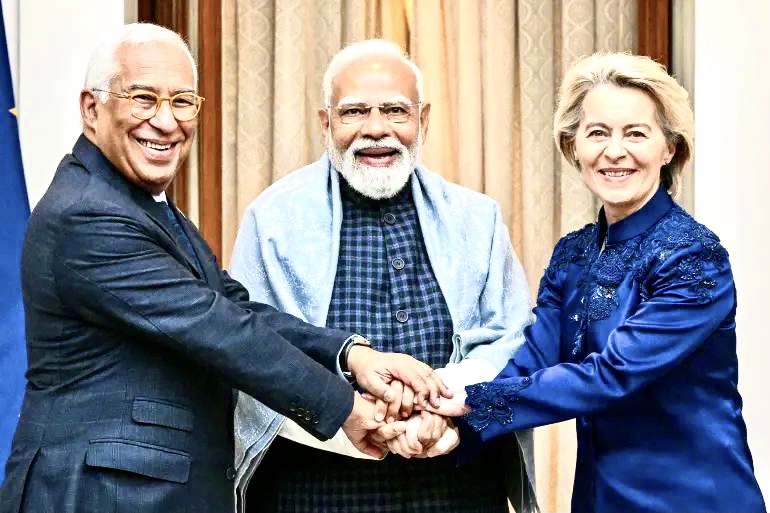
The European Union (EU) and India have concluded negotiations on a free trade deal, European Commission, President Ursula von der Leyen, and India’s Prime Minister, Narendra Modi, have said.
“The EU and India make history today, deepening the partnership between the world’s biggest democracies.
“We have created a free trade zone of two billion people, with both sides set to gain economically.
“We have sent a signal to the world that rules-based cooperation still delivers great outcomes,” von der Leyen said.
She said, during an EU-India summit in New Delhi.
Under the deal, India is to gradually reduce tariffs on imported cars from 110 per cent to as low as 10 per cent, at least for 250,000 vehicles per year.
Also, the tariffs on car parts are to be abolished after five to 10 years, the commission said.
Tariffs on machinery, chemicals and pharmaceuticals are also to be mostly eliminated, it said.
Duties on some EU agricultural products are also to be lowered significantly.
Tariffs on wine would be cut from 150 per cent to 75 per cent and the 40 per cent-levy on olive oil is to be removed.
Similar protests to the Mercosur agreement are not expected, as the agreement will not include sensitive areas for local farmers.
“Sensitive European agricultural sectors will be fully protected,” the commission said.
Products such as beef, chicken meat, rice and sugar, were excluded from the deal and EU standards to continue to apply to all Indian imports, it said.
The deal will have to be formally adopted by EU countries, as well as the European Parliament before it can enter into force.
With a population of more than 1.45 billion, India is the world’s most populous country, ahead of China.
The EU is home to around 450 million people.
India and the EU account for nearly a quarter of the world’s population and global gross domestic product (GDP).
The negotiations on the free trade deal initially started in 2007 but were suspended in 2013 over a lack of progress.
Russia’s full-scale invasion of Ukraine led to the relaunch of the talks in 2022, and U.S. President Donald Trump’s tariff policy spurred rapid progress. (dpa/NAN)