
By Okey IBEKE
Smuggling in Nigeria is no longer merely an economic crime involving the evasion of customs duties or loss of government revenue. It has evolved into one of the country’s most serious public health, national security and environmental challenges. Counterfeit medicines, illicit narcotics, expired food products and other prohibited goods continue to enter the country through illegal routes, exposing millions of Nigerians to preventable illness, addiction and even death.
From fake antibiotics that worsen infections to codeine syrup and tramadol that fuel drug abuse among young people, the consequences of smuggling extend far beyond commerce. Expired pharmaceuticals repackaged for sale, contaminated consumables and dangerous chemicals not only undermine legitimate businesses but also place countless lives at risk.
Smuggling involves the unlawful movement of goods across borders, seaports and airports to evade customs duties, import restrictions or regulatory controls. While its economic consequences remain significant, its impact on public health has become increasingly alarming.
Nigeria’s geography presents formidable enforcement challenges. The country shares about 4,047 kilometres of land borders with neighbouring countries and has an estimated 1,500 illegal crossing routes. Monitoring such an extensive network is difficult, even for well-equipped security agencies. These challenges are compounded by inadequate infrastructure, manpower limitations and the ingenuity of organised smuggling syndicates.
Weak border control, however, is only part of the problem. Years of neglect have left many border communities without good roads, healthcare facilities, schools, electricity or meaningful employment opportunities. In states such as Ogun, Katsina, Kebbi, Cross River and Adamawa, poverty has made smuggling an attractive source of livelihood for many residents.
Long-standing cultural and family ties between border communities in Nigeria and neighbouring countries also facilitate illegal trade. Communities such as Seme, Idiroko, Jibia, Illela and Mfum have maintained cross-border relationships for generations. In many cases, locals who see little government presence beyond security checkpoints become vulnerable to recruitment by smuggling networks as transporters, informants and couriers.
The country’s deteriorating security environment has further complicated anti-smuggling operations. Terrorists, bandits and other armed non-state actors increasingly exploit porous borders to traffic illicit goods, making enforcement more dangerous and strengthening the link between smuggling and organised crime.
At Nigeria’s seaports, smugglers have adopted increasingly sophisticated methods to evade detection. False declarations, under-valuation, concealment and misclassification are now common tactics. Narcotics have been discovered hidden inside vehicle parts, compressors, household appliances and imported vehicles, while counterfeit medicines are sometimes declared as industrial chemicals to escape regulatory scrutiny.
The public health consequences are enormous. Counterfeit and substandard medicines contribute to treatment failures, prolonged illnesses, antimicrobial resistance and preventable deaths. Smuggled narcotics such as tramadol, codeine and cannabis have fuelled rising cases of drug dependency, cultism, kidnapping, armed robbery and other violent crimes. Medical experts warn that prolonged use of unregulated drugs can cause liver and kidney failure, neurological disorders and severe psychiatric conditions.
The economic costs are equally severe. Counterfeit products undermine legitimate pharmaceutical manufacturers, discourage investment, reduce employment and deny government much-needed revenue. The proceeds from illicit trade have also been linked to money laundering, arms trafficking, insurgency and terrorism financing, making smuggling a direct threat to national security.
Environmental protection has become another critical dimension of Customs enforcement. Nigeria has emerged as a transit route for illegal wildlife trafficking, prompting intensified efforts by the Nigeria Customs Service to intercept endangered species and wildlife products. In June 2026, Customs intercepted 22 elephant tusks weighing 130.84 kilograms, valued at over ₦126 million, reinforcing Nigeria’s commitment to international conservation agreements.
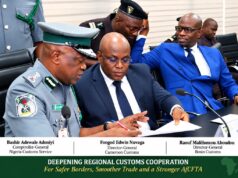
Recognising that traditional enforcement methods were no longer sufficient, the Comptroller-General of the Nigeria Customs Service, Bashir Adewale Adeniyi, initiated sweeping reforms to modernise the Service’s anti-smuggling operations. His strategy combines intelligence-driven enforcement, advanced technology, stronger inter-agency collaboration, community engagement and more vigorous prosecution of offenders.
Since assuming office in June 2023, the Service has upgraded the Nigeria Integrated Customs Information System (NICIS II) to the indigenous B’Odogwu platform, expanded the deployment of non-intrusive inspection scanners at major ports, strengthened surveillance along vulnerable borders and improved intelligence gathering through risk profiling and data analysis.
Collaboration with the National Drug Law Enforcement Agency (NDLEA), the National Agency for Food and Drug Administration and Control (NAFDAC) and the Nigeria Agricultural Quarantine Service has also intensified through intelligence sharing, joint operations and coordinated enforcement activities. Operational units such as the Federal Operations Units have been revitalised, while specialised formations, including the Special Wildlife Office, have enhanced enforcement against environmental crimes.
These reforms have produced measurable results. Since 2024, the annual Duty Paid Value of seizures has consistently exceeded ₦50 billion, while prosecutions for smuggling-related offences have increased significantly under the provisions of the Nigeria Customs Service Act, 2023.
Recent interceptions illustrate the scale of the threat. In June 2026, the Apapa Area Command intercepted a 40-foot container carrying 3,639 sachets of Cannabis Sativa weighing 1,819 kilograms, alongside two containers loaded with expired pharmaceuticals intended for relabelling. The combined Duty Paid Value exceeded ₦12.7 billion.
At Tin Can Island Port, Customs officers intercepted another container from Canada carrying more than 4,100 kilograms of Cannabis Indica valued at nearly ₦17 billion. Another operation uncovered 185 jumbo bags containing 9,450 packages of cannabis concealed inside imported vehicles, with a Duty Paid Value of about ₦19 billion.
The Federal Operations Unit, Zone A, also intercepted nearly 600,000 tablets of Tramadol Hydrochloride concealed inside a Toyota Hilux along the Ijebu-Ode corridor. Similar seizures of narcotics, prohibited poultry products and other contraband were recorded by the Seme and Ogun I Area Commands.
Collectively, Customs formations nationwide have seized approximately 15,000 kilograms of cannabis, 500 kilograms of cocaine, 3.2 million tablets of Tramadol 225mg, millions of bottles of codeine syrup, numerous containers of counterfeit pharmaceuticals and large quantities of wildlife products between 2023 and 2026. These interceptions undoubtedly prevented potentially catastrophic public health consequences.
The campaign against smuggling has, however, come at a heavy price. Criminal syndicates have increasingly launched violent attacks against Customs personnel. Several officers have been killed or seriously injured during anti-smuggling operations, particularly along the Ogun border corridor.
On February 3, 2026, Assistant Superintendent of Customs I Mustapha Akiyode was killed during an ambush by suspected smugglers at Ilara-Ijoun in Ogun State, while two other officers sustained serious injuries. Similar attacks have occurred in Ogun, Kebbi and Adamawa States, highlighting the growing sophistication and desperation of criminal networks.
In response, the Nigeria Customs Service has strengthened operational capacity through improved weapons training, enhanced surveillance capabilities, acquisition of modern equipment and stricter enforcement of relevant provisions of the Nigeria Customs Service Act against those who attack enforcement personnel.
The anti-smuggling campaign aligns closely with President Bola Ahmed Tinubu’s Renewed Hope Agenda by promoting public health, strengthening national security, protecting the environment and supporting economic growth. Every illicit drug intercepted reduces the risk of addiction. Every counterfeit medicine seized saves lives. Every successful enforcement operation protects legitimate businesses and safeguards government revenue needed for healthcare, education and infrastructure.
Nevertheless, enforcement alone cannot eliminate smuggling. Lasting success requires sustained investment in border communities through improved roads, healthcare, schools, electricity and employment opportunities. Communities that benefit from development are less likely to become safe havens for criminal enterprises.
Ultimately, the fight against smuggling is a shared national responsibility. Government agencies, traditional institutions, community leaders, the private sector and citizens all have important roles to play. Public cooperation, intelligence sharing and the refusal to patronise suspiciously cheap products remain essential to reducing illicit trade.
The Nigeria Customs Service remains the nation’s first line of defence against dangerous imports. By preventing counterfeit medicines, illicit drugs and other harmful products from entering the country, it is not only protecting Nigeria’s economy but also preserving lives, strengthening national security and safeguarding the health and future of every Nigerian.
Okey IBEKE is the Publisher of Business and Maritime West Africa.