

By Okey IBEKE
When President Bola Ahmed Tinubu assumed office in May 2023, he inherited an economy grappling with declining foreign exchange earnings, rising unemployment, dwindling industrial productivity, and an overdependence on crude oil revenues. Recognising that the old economic model had become increasingly unsustainable, his administration unveiled the Renewed Hope Agenda, an ambitious reform blueprint designed to reposition Nigeria’s economy through diversification, industrialisation, investment promotion, increased local production, and aggressive expansion of non-oil exports.
At the heart of this strategy lies a simple but profound economic philosophy: Nigeria must produce more, export more, earn more foreign exchange, create more jobs and reduce its dependence on crude oil.
Three years into the implementation of the agenda, there are encouraging signs that manufacturers, farmers and exporters have begun responding positively to the government’s incentives. The value of non-oil exports has continued to rise, while Nigerian agricultural commodities and manufactured products are finding increasing acceptance in regional and international markets.
Ironically, just as exporters are responding to government policies, a major obstacle has emerged—not on the farms or factory floors—but within the country’s maritime logistics chain.
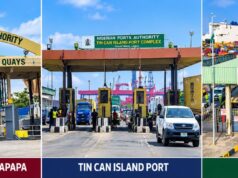
The revelation by the Nigerian Shippers’ Council (NSC) that no fewer than 1,800 export containers were trapped at APM Terminals, Apapa, because of delays in shipment by Maersk Line raises questions that go far beyond ordinary operational challenges. It raises concerns about whether weaknesses within the shipping industry are beginning to undermine the Federal Government’s carefully designed economic recovery programme.
The development should worry policymakers because exports are no longer viewed merely as commercial transactions. They are central to Nigeria’s economic recovery strategy. Every successful export shipment translates into foreign exchange earnings, increased industrial production, employment opportunities, higher tax revenues and improved national economic stability.
Recognising this reality, the Tinubu administration has implemented several reforms intended to encourage export-oriented production. The government has strengthened export promotion programmes, sustained the Export Expansion Grant administered by the Nigerian Export Promotion Council, embarked on foreign exchange reforms to improve market efficiency, encouraged investment in local manufacturing, promoted value addition to agricultural products, supported trade facilitation initiatives at the ports, and actively positioned Nigeria to benefit from the African Continental Free Trade Area (AfCFTA).
Government agencies have equally aligned with these objectives. The Nigeria Customs Service has accelerated trade facilitation through digitalisation, improved cargo clearance procedures, expansion of the Authorised Economic Operator Programme, dedicated export terminals and modernisation of customs processes. The Nigerian Ports Authority has continued efforts to improve port efficiency, while the Nigerian Shippers’ Council has intensified its role as economic regulator of the ports to protect the interests of importers and exporters.
These reforms have started yielding results. Products such as hibiscus flowers, sesame seeds, cocoa, ginger, cashew, fertiliser, manufactured goods and other processed agricultural commodities are increasingly contributing to Nigeria’s non-oil export earnings. This represents exactly the kind of economic transformation envisioned under the Renewed Hope Agenda.
However, increasing production alone cannot deliver economic prosperity if the products cannot reach international markets when buyers expect them.
That is precisely why the recent disclosure by the Nigerian Shippers’ Council deserves serious national attention.
According to the Council, approximately 1,800 export containers became stranded at APM Terminals, Apapa, following congestion and repeated vessel rescheduling by Maersk Line. The affected cargoes, largely hibiscus flowers destined for African and Far Eastern markets, remained trapped despite exporters having fulfilled their contractual obligations by producing the goods, delivering them to the ports and paying the necessary freight charges.
The implication is obvious.
Nigeria successfully encouraged production. Exporters successfully secured foreign buyers. The cargo reached the port. Yet the goods could not leave the country.
For an administration that has consistently promoted exports as a major pillar of economic recovery, this represents a significant policy contradiction.
The consequences extend beyond temporary inconvenience. International trade operates on reliability. Overseas buyers expect suppliers to deliver products according to agreed schedules. Delays often attract contractual penalties, force buyers to source alternative suppliers or, in some cases, result in outright rejection of consignments.
Although hibiscus flowers have a relatively longer shelf life than many agricultural products, prolonged storage under unfavourable conditions can reduce quality and market value. Buyers in Europe, Asia and the Middle East operate under strict quality specifications. A delayed shipment may arrive in technically acceptable condition but still fail to meet commercial expectations because of diminished freshness, colour, moisture content or contractual delivery timelines. When such situations occur, it is usually the Nigerian exporter—not necessarily the shipping line—that suffers reputational damage. Perhaps more importantly, delayed exports postpone foreign exchange inflows into Nigeria’s economy.
One of the principal objectives of the Renewed Hope Agenda is to increase the country’s foreign exchange earnings outside crude oil exports. Every container trapped unnecessarily at the ports delays inflows of export proceeds, weakens cash flow for exporters, discourages production and ultimately reduces Nigeria’s competitiveness in international trade.
This is particularly significant under the African Continental Free Trade Area, where Nigeria hopes to emerge as one of Africa’s leading manufacturing and export hubs. Regional competitors such as Ghana, Kenya, Côte d’Ivoire, Ethiopia and South Africa are also aggressively expanding their export capacities. In such a competitive environment, buyers have little patience for unreliable delivery schedules.
The warning issued by the Nigerian Shippers’ Council therefore deserves commendation. By reminding Maersk Line that it could be held liable if delayed cargo arrives in deteriorated condition and is subsequently rejected, the Council demonstrated the regulatory vigilance expected of an economic regulator. The assurance that claims and refunds would be pursued on behalf of affected exporters also sends a positive signal that exporters will not be left entirely at the mercy of operational failures within the shipping system.
Nevertheless, the incident raises broader policy questions. If Nigeria is genuinely committed to export-led growth, should shipping lines be permitted to accept export bookings without adequate vessel capacity? Should repeated vessel rollovers become a normal feature of Nigeria’s export logistics? Are terminal operators providing sufficient infrastructure to support increasing export volumes? Why should exporters bear financial losses arising from circumstances entirely outside their control?
These are questions that policymakers can no longer ignore.
The irony is that shipping companies had, until recently, complained about inadequate export cargo from Nigeria. According to the Nigerian Shippers’ Council, the narrative has changed dramatically. Export volumes have increased to the point where shipping capacity is now struggling to cope with demand. Ordinarily, this should be good news.
Instead, it has exposed weaknesses within Nigeria’s maritime logistics chain that threaten to erode the gains of government reforms.
The situation also highlights an important economic reality: export promotion does not end with encouraging production. Efficient logistics are equally indispensable.
Every participant within the supply chain—including shipping lines, terminal operators, freight forwarders, customs authorities, port managers and regulators—must function efficiently if Nigeria is to maximise the benefits of its export promotion policies.
Government cannot encourage manufacturers to produce for international markets while logistics failures prevent the products from reaching those markets. The private sector equally has responsibilities.
Shipping companies operating in Nigeria are critical partners in national economic development. Their commercial decisions have direct implications for foreign exchange earnings, industrial growth, employment generation and investor confidence. While operational challenges such as port congestion and global shipping disruptions are realities of international trade, exporters deserve transparency, predictable schedules and timely communication whenever disruptions occur.
Going forward, stronger collaboration between the Nigerian Shippers’ Council, the Nigerian Ports Authority, the Nigeria Customs Service, terminal operators and shipping companies will be essential. Government may also consider introducing minimum service standards for export cargo evacuation, periodic performance reviews of shipping lines, improved scheduling transparency and stronger regulatory sanctions where avoidable delays inflict measurable economic losses.
Beyond regulation, Nigeria must accelerate investment in dedicated export terminals, modern cargo handling infrastructure, rail connectivity to ports and inland export processing facilities to reduce dependence on congested port corridors.
Ultimately, President Tinubu’s economic recovery plan will not be judged solely by the policies announced in Abuja but by their practical outcomes across farms, factories and seaports. The success of the Renewed Hope Agenda depends not only on encouraging Nigerians to produce more but also on ensuring that what they produce reaches global markets efficiently, competitively and on time. The 1,800 stranded export containers at Apapa should therefore serve as an urgent wake-up call.
If Nigeria is serious about becoming an export-driven economy, every link in the logistics chain must work with the same sense of urgency as the producers themselves. Otherwise, the country’s economic ambitions risk being trapped at the ports alongside its export containers.