By John Kato
The Minister of Marine and Blue Economy, Adegboyega Oyetola, has declared that the President Bola Tinubu administration has fundamentally altered the trajectory of Nigeria’s maritime sector through far-reaching institutional, policy and infrastructure reforms, saying the challenge now is to sustain the momentum and consolidate the gains already recorded.
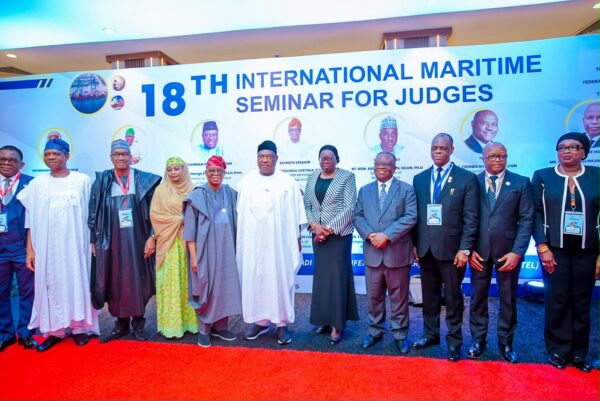
The minister stated this on Wednesday in Abuja while declaring open the 18th International Maritime Seminar for Judges, an annual capacity-building programme organised by the Nigerian Shippers’ Council (NSC) in collaboration with the National Judicial Institute (NJI) under the auspices of the Federal Ministry of Marine and Blue Economy.
The seminar, which has become one of the country’s most important forums for strengthening maritime jurisprudence, brings together judicial officers, maritime lawyers, regulators, academics and industry stakeholders to examine emerging developments in maritime law, international trade and dispute resolution.
Oyetola said the establishment of the Federal Ministry of Marine and Blue Economy in 2023 by President Tinubu marked a strategic shift in the country’s economic development agenda by recognising the maritime sector as a major driver of economic diversification, trade facilitation, food security, environmental sustainability, employment creation and foreign direct investment.
According to him, the administration has since embarked on comprehensive reforms aimed at repositioning Nigeria as a leading maritime nation in Africa while unlocking the enormous economic potential of its marine and blue economy.
He commended the Nigerian Shippers’ Council for sustaining the International Maritime Seminar for Judges over the years, describing it as one of Nigeria’s foremost platforms for enhancing judicial competence in maritime law and ensuring that the nation’s judiciary remains abreast of rapidly evolving international legal developments.
He noted that maritime commerce operates within a highly specialised legal environment where judicial decisions significantly influence commercial confidence, shipping investments and international trade.
“President Bola Tinubu’s administration has fundamentally changed the trajectory of the maritime sector through deliberate reforms that are already delivering measurable economic and institutional results.
“Our responsibility now is to sustain these reforms by strengthening institutions, promoting legal certainty and expanding opportunities across the blue economy.
“A predictable judicial system remains indispensable to protecting investments and supporting Nigeria’s aspiration to become Africa’s leading maritime nation,” he said.
The minister observed that maritime law has become increasingly sophisticated due to rapid technological innovation and evolving global shipping practices.
He said judicial officers must therefore continuously update their knowledge to effectively adjudicate disputes arising from emerging technologies, environmental obligations and digital commercial transactions.
According to him, technological innovations such as autonomous vessels, artificial intelligence-powered navigation systems, electronic bills of lading, blockchain-enabled cargo documentation and digital shipping platforms are creating entirely new legal questions requiring specialised judicial expertise.
He explained that courts across the world are increasingly being called upon to determine complex issues involving liability arising from autonomous shipping operations, allocation of responsibility where artificial intelligence systems malfunction, cyber security breaches affecting vessels and ports, insurance claims relating to automated navigation systems and compliance with increasingly stringent international environmental regulations.
“The emergence of autonomous vessels demands a judiciary equipped to resolve complex legal questions involving liability, insurance, navigation and technological accountability.
“Rapid technological advancement is creating unprecedented legal questions relating to liability, navigational responsibility, insurance, collision regulations and allocation of responsibility when autonomous vessels malfunction.
“The courts will increasingly adjudicate disputes involving decarbonisation, environmental compliance, blockchain-enabled cargo documentation, electronic bills of lading and other evolving international maritime legal frameworks.
“Judicial officers must remain abreast of evolving international maritime law to ensure justice keeps pace with technological innovation.
“A knowledgeable judiciary remains fundamental to strengthening confidence in Nigeria’s maritime legal system and dispute resolution framework,” Oyetola stated.
The minister emphasised that efficient adjudication of maritime disputes remains critical to Nigeria’s ambition of becoming a preferred destination for shipping business and maritime investment.
He explained that delays in resolving commercial disputes often discourage investors, increase business costs and divert maritime transactions to competing jurisdictions.
According to him, every judgment delivered by Nigerian courts in maritime matters sends a strong signal to the international shipping community regarding the country’s legal certainty, institutional credibility and investment climate.
He assured stakeholders that the Federal Government would continue to support the development of specialised maritime divisions within the Federal High Court, promote alternative dispute resolution through maritime arbitration and align Nigeria’s maritime legislation with evolving international conventions and best global practices.
The minister also pledged closer collaboration between the Federal Ministry of Marine and Blue Economy, its agencies and the judiciary to provide technical expertise that would assist judges in handling increasingly specialised maritime disputes.
“Every maritime judgment sends a powerful signal to investors, ship owners, insurers and commercial operators about the credibility of Nigeria’s justice system.
“Predictable and well-reasoned judicial decisions encourage parties to utilise Nigerian courts and arbitration centres for maritime dispute resolution.
“Judicial excellence is not merely a legal objective; it is an important pillar of commercial confidence and institutional credibility,” he said.
Highlighting achievements recorded under the Tinubu administration, Oyetola said the creation of the Federal Ministry of Marine and Blue Economy itself represented a landmark policy decision designed to give greater strategic attention to Nigeria’s vast maritime resources.
He said the ministry had successfully developed Nigeria’s first National Policy on Marine and Blue Economy, providing a comprehensive framework for the sustainable development of the country’s ocean resources and maritime assets.
The minister also pointed to Nigeria’s sustained record of zero piracy incidents in its territorial waters for four consecutive years, describing it as a major accomplishment that has significantly improved the country’s international maritime reputation and enhanced confidence among shipowners and global shipping companies.
He disclosed that government recently secured a £746 million financing agreement for the reconstruction and modernisation of Apapa and Tin Can Island Ports, two of Nigeria’s busiest gateway ports, to improve cargo handling efficiency, reduce vessel turnaround time and strengthen the country’s trade competitiveness.
Oyetola further listed the Federal Government’s approval for the long-awaited disbursement of the Cabotage Vessel Financing Fund (CVFF) as another milestone expected to boost indigenous shipping capacity by providing Nigerian shipowners with access to affordable financing for vessel acquisition.
He noted that Nigeria’s successful re-election into Category C of the International Maritime Organization (IMO) Council after a 15-year absence further reflected renewed international confidence in the country’s maritime governance and growing influence within global maritime affairs.
According to him, reforms in fisheries and aquaculture are equally contributing to increased fish production, improved food security and employment opportunities across coastal communities.
The minister revealed that agencies under the Federal Ministry of Marine and Blue Economy generated over ₦1.8 trillion in revenue in 2025, underscoring the increasing contribution of the maritime sector to Nigeria’s economy and demonstrating the effectiveness of ongoing reforms under the Renewed Hope Agenda.
“These milestones demonstrate that the marine and blue economy has become a major contributor to national economic growth under the Renewed Hope Agenda.
“Infrastructure development and policy reforms must be complemented by a judiciary that delivers timely, fair and commercially predictable decisions.
“Investor confidence depends not only on sound policies but also on the integrity, consistency and professionalism of our judicial system,” he said.
In her remarks, the Chief Justice of Nigeria (CJN), Justice Kudirat Kekere-Ekun, stressed that maritime disputes are inherently complex because they frequently involve multiple jurisdictions, international conventions, shipping contracts, marine insurance, cargo claims and cross-border commercial transactions.
She noted that because shipping underpins global trade, any delay in the resolution of maritime disputes could have significant economic consequences by increasing operational costs, disrupting supply chains and discouraging investment.
According to the Chief Justice, a specialised and efficient admiralty justice system remains indispensable for promoting commercial certainty, protecting contractual rights and strengthening Nigeria’s competitiveness as a maritime nation.
She also underscored the importance of sustained judicial cooperation among courts across jurisdictions, maritime regulators, legal practitioners and international organisations, noting that maritime commerce transcends national boundaries and therefore requires harmonised legal approaches.
Kekere-Ekun described the seminar as an invaluable platform for continuous judicial education, knowledge exchange and capacity development, saying it would further strengthen maritime jurisprudence and improve the quality of admiralty justice in Nigeria.
Participants at the seminar are expected to examine contemporary issues in maritime law, including developments in international shipping regulation, digitalisation of maritime commerce, environmental obligations, alternative dispute resolution, marine insurance, port operations and emerging trends in global admiralty practice.