

Nigeria’s emerging digital Customs architecture is set to provide the template for a $3.1 billion African Continental Free Trade Area (AfCFTA) Customs Modernisation Project aimed at harmonising customs procedures and facilitating the movement of goods across African borders.
The Infrastructure Concession Regulatory Commission (ICRC) said the adoption of Nigeria’s Customs Modernisation Project as the model for the continental initiative was a major demonstration of the potential of properly structured Public-Private Partnerships (PPPs) to deliver strategic infrastructure and technology projects.
The ICRC said the development also represented an important milestone for Nigeria’s home-grown technology industry, as the digital platform at the centre of the Nigerian Customs transformation, B’Odogwu, was developed locally and is being deployed by the Nigeria Customs Service (NCS).
Acting Head of Media and Publicity of the ICRC, Ifeanyi Nwoko, disclosed this in a statement in Abuja on Tuesday, quoting the Director-General of the commission, Dr Jobson Ewalefoh.
Ewalefoh was reacting to the recent agreement between the AfCFTA Secretariat and Bergmans Security Consultants and Supplies Ltd., the parent company associated with the Trade Modernisation Project, for the implementation of the AfCFTA Customs Modernisation Project.
The agreement provides for a 20-year concession to deploy digital and physical customs infrastructure across AfCFTA State Parties, with the objective of creating greater interoperability among national customs administrations and supporting the development of a single African market.
The project is expected to harmonise customs processes, improve border management, strengthen trade corridors and reduce the delays and administrative bottlenecks that have historically hindered intra-African trade. Recent reports indicate that the continental system is expected to begin deployment in a number of African countries before being expanded more widely.
From Nigerian experiment to continental platform
Ewalefoh said the decision to adopt the Nigerian model was significant because it demonstrated that an African country could develop and deploy a sophisticated Customs technology platform capable of supporting wider regional integration.
“Africa is not just adopting a piece of technology. Africa is adopting a Nigerian idea, built by Nigerians, proven on Nigerian soil, and now trusted to carry the trade ambitions of an entire continent.”
He said the development demonstrated what could be achieved when PPP arrangements were properly structured, regulated and supported by government.
“This is what PPPs, properly structured and properly regulated, can deliver,” he said.
The ICRC boss made the remarks during a monitoring and compliance visit to the Nigeria Customs Modernisation Project on Aug. 7, where he reviewed the implementation of B’Odogwu, the Unified Customs Management System being deployed under the Nigerian Customs modernisation arrangement.
B’Odogwu is designed to replace legacy Customs processes with a more integrated and automated system for cargo declaration, assessment, processing and clearance. Its phased deployment has been taking place across Customs Area Commands, as part of the NCS drive towards a more digital, transparent and trade-friendly Customs administration.
The NCS has described the system as a home-grown response to some of the limitations associated with the former Nigeria Integrated Customs Information System (NICIS II), with the objective of improving trade facilitation, compliance and revenue collection.
PPP model under scrutiny
Ewalefoh said the success of the Nigerian project was particularly important because the Customs modernisation initiative had initially encountered scepticism over whether the private-sector partners would be able to deliver the required technology and infrastructure.
“When this project came on board, there were a lot of doubts, but today, what we are seeing is amazing,” he said.
According to him, the project’s evolution demonstrated the importance of government providing the right regulatory framework while allowing private capital, technology and expertise to complement public-sector resources.
The ICRC, which regulates PPPs in Nigeria, has previously described the Customs Modernisation Project as a presidential initiative designed to establish a modern, digital and largely paperless Customs administration. The Nigerian concession was structured as a 20-year PPP involving the NCS and Trade Modernisation Project, with technology and financing partners.
The commission has argued that such arrangements allow government to mobilise large-scale private investment for infrastructure without relying exclusively on public borrowing.
Ewalefoh said the Customs project therefore offered an example of how private capital could be deployed to improve public-sector efficiency while supporting government revenue generation.
“Every Naira of private investment that goes into infrastructure like this is a Naira the government does not have to borrow, while the returns, in revenue and efficiency, still accrue to the country,” he said.
Nigerian technology gains continental recognition
The ICRC DG also highlighted the indigenous character of B’Odogwu, describing it as evidence that Nigerian engineers and technology professionals could develop solutions capable of competing beyond the domestic market.
He said the technology was not simply imported from a foreign provider but developed through Nigerian expertise and subsequently deployed within the country’s Customs environment.
The continental adoption of the model could therefore mark a shift in the perception of Nigeria from being primarily a consumer of imported technology to becoming a provider of digital infrastructure and expertise for other African economies.
The AfCFTA Secretariat’s customs modernisation agenda is particularly important because differences in national customs systems remain one of the practical obstacles to seamless intra-African trade. The continental project seeks to address this fragmentation by improving interoperability and harmonising border procedures.
For businesses, particularly manufacturers, exporters, importers and small and medium-sized enterprises, more interoperable customs systems could translate into shorter clearance times, greater predictability and lower transaction costs.
The wider objective is to make the AfCFTA’s promise of a single African market more practical by ensuring that goods can move across borders with fewer procedural and technological barriers.
Adeniyi commended for Customs transformation
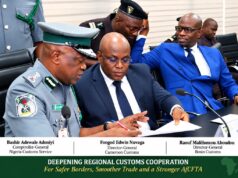
Ewalefoh commended the Comptroller-General of the NCS, Bashir Adewale Adeniyi, for his role in driving the digital transformation of the Service and sustaining the deployment of B’Odogwu across Customs commands.
He said the progress made in implementing the system had contributed to the confidence now being placed in Nigeria’s Customs modernisation experience at the continental level.
The development also comes as the NCS continues to expand the use of B’Odogwu across its commands, with the system increasingly positioned as a central component of the Service’s broader strategy to modernise Customs operations, improve compliance and facilitate legitimate trade.
Beyond Customs
Ewalefoh said the Customs project should also be viewed within the wider context of Nigeria’s infrastructure development strategy, pointing to the Lekki Deep Sea Port as another example of private capital being deployed through a PPP structure.
He said the experience was consistent with the Federal Government’s ambition of building a larger and more productive Nigerian economy, particularly under its long-term development plans, which place considerable emphasis on private-sector investment in infrastructure.
He also linked the AfCFTA development to his recent advocacy for stronger regional cooperation on PPPs, saying the Nigerian experience showed how a nationally implemented project could eventually provide a platform for continental integration.
“What we are seeing with AfCFTA today is the regional cooperation I called for in Abidjan taking concrete shape. One country’s well-regulated PPP can become the infrastructure backbone of an entire continent,” he said.
He dismissed concerns that greater automation could lead to significant job losses, arguing that the modernisation project had instead created opportunities for Nigerian engineers, technology professionals and other skilled workers while improving Customs revenue administration.
The development, analysts say, places Nigeria’s Customs reform at the intersection of digitalisation, trade facilitation, revenue mobilisation and AfCFTA integration.
If successfully replicated across participating African countries, the Nigerian model could ultimately become more than a Customs technology project: it could serve as a practical digital infrastructure layer for the movement of goods across the continent and help turn AfCFTA from a trade-policy framework into a more seamless operational market.