
Nigeria and India are seeking to rebuild their economic relationship and return bilateral trade to its previous peak of nearly $15 billion, with renewed Indian purchases of Nigerian crude oil emerging as a major plank of the proposed trade revival.
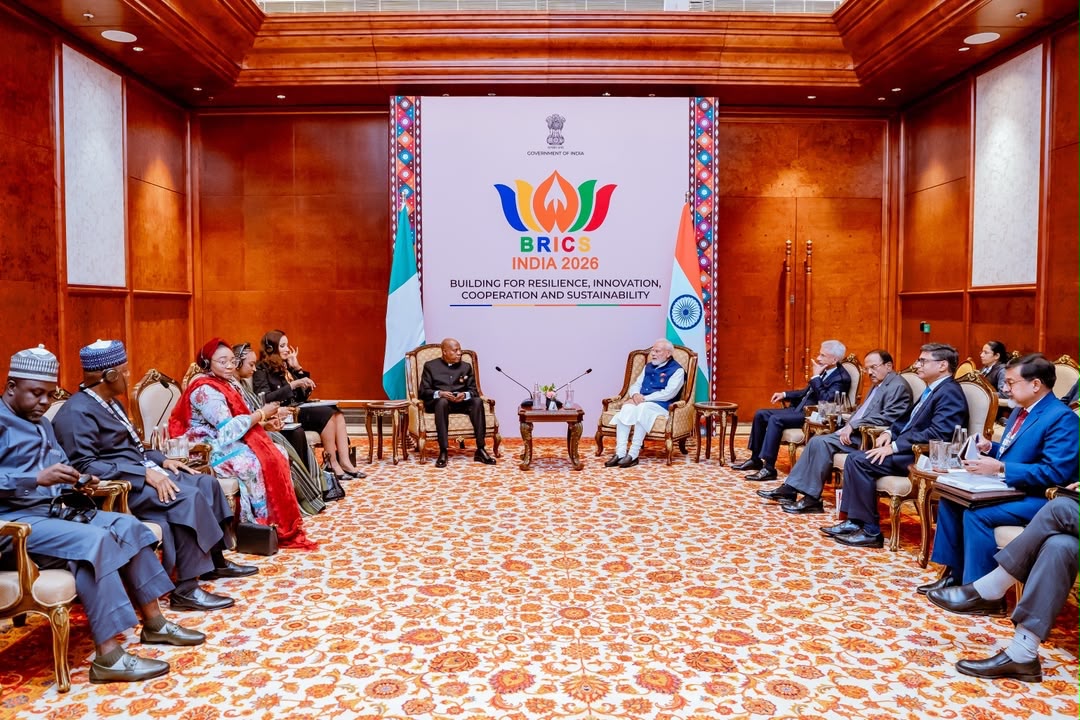
The commitment followed a bilateral meeting between Vice President Kashim Shettima and Indian Prime Minister Narendra Modi in New Delhi on the sidelines of the recently concluded BRICS Leaders’ Summit.
The renewed engagement comes against the backdrop of a significant decline in Nigeria-India trade over the past few years, largely associated with the sharp reduction in India’s purchases of Nigerian crude oil.
According to figures disclosed by the Indian High Commissioner to Nigeria, Abhishek Singh, bilateral trade reached $14.95 billion in the 2021–2022 financial year before falling to $7.13 billion in 2024–2025. It subsequently recovered to about $9 billion in 2025–2026.
The figures highlight both the scale of the commercial relationship and its vulnerability to changes in the global energy market. Nigeria and India have historically maintained strong trading links, but crude oil has played an outsized role in determining the value of their bilateral trade.
India is one of the world’s major energy-consuming economies, while Nigeria is one of Africa’s significant oil producers. Consequently, fluctuations in Indian demand for Nigerian crude can have a substantial effect on the overall value of trade between the two countries.
It was against this background that Modi made a case for renewed Indian purchases of Nigerian crude, arguing that stronger energy ties could help restore the broader commercial relationship.
For Nigeria, however, the challenge is to ensure that a revival in crude sales does not simply reproduce the structure that produced the earlier trade peak. While increased oil exports could quickly raise the headline value of bilateral trade, the longer-term objective is to develop a relationship driven increasingly by investment, manufacturing, technology, services and value-added exports.
Shettima indicated that this was the direction of the Tinubu administration’s thinking.
He said Nigeria would consider India’s request within the broader strategy of President Bola Tinubu’s administration to attract foreign investment and build strategic partnerships capable of expanding the country’s productive capacity and strengthening domestic industries.
“The Tinubu administration is particularly interested in moving Nigeria’s relationship with India beyond the traditional exchange of commodities,” Shettima said.
The Vice President said Nigeria wanted international partnerships that would create jobs, facilitate technology and skills transfer, support industrialisation and unlock opportunities for the country’s large youth population.
He identified pharmaceuticals, defence, digital technology and the creative industries as priority areas for expanding Nigerian-Indian cooperation.
The emphasis is significant because India has developed considerable capabilities in sectors in which Nigeria has substantial domestic demand. Pharmaceuticals, information technology, digital services, healthcare, manufacturing and financial technology offer opportunities for a relationship in which Indian investment could contribute directly to production within Nigeria rather than merely supplying the Nigerian market from abroad.
The two leaders also discussed cooperation in renewable and clean energy, power, healthcare, capacity building and financial technology, reflecting the increasingly broad scope of the bilateral relationship.
Particular attention was also given to digital technology and fintech, with both countries exploring opportunities to build on previous cooperation around digital public infrastructure.
For Nigeria, such cooperation could become particularly important as the country seeks to deepen digital financial inclusion, improve public-service delivery and expand the technology ecosystem.
Both leaders agreed that stronger private-sector participation would be central to the next phase of bilateral relations. They identified sectors where Indian companies have substantial expertise and where Nigerian demand remains strong as areas for deeper commercial collaboration.
Beyond the $15bn headline
The ambition to return bilateral trade to almost $15 billion should therefore be viewed as more than a target for restoring a historical figure.
The composition of that trade will matter as much as its value.
A return to $15 billion driven overwhelmingly by crude oil would increase export earnings but would leave the underlying structure of the relationship largely unchanged. A more durable expansion would combine energy exports with greater Nigerian participation in pharmaceuticals, agro-processing, manufacturing, digital services, healthcare, technology and other areas of value addition.
This is particularly important as Nigeria seeks to improve its position in global and African value chains and take greater advantage of the African Continental Free Trade Area.
India’s large market and industrial base also provide opportunities for Nigerian exporters, particularly if Nigeria can increase the volume and sophistication of non-oil products entering the Indian market.
The trade relationship has therefore reached a point where the central question is not simply how to restore the lost billions, but how to make the next phase of Nigeria-India commerce more balanced, productive and investment-driven.
Women and grassroots enterprise
The renewed economic engagement also extends beyond government-to-government trade.
Minister of Women Affairs, Imaan Sulaiman-Ibrahim, said Nigeria was drawing lessons from India’s women-led self-help group model to strengthen financial inclusion and grassroots enterprise under the Nigeria for Women Programme Scale-Up.
According to the minister, the programme will use Women Affinity Groups to connect women with finance, skills and markets.
She said the initiative was part of the Federal Government’s broader effort to increase women’s participation in productive economic activity while strengthening social protection and interventions against sexual and gender-based violence.
“Women’s economic empowerment is fundamental to our ambition of building a $1 trillion economy.
“We must deliberately bring millions more Nigerian women into productive economic activity,” the minister said.
India’s experience with large-scale women-led community and enterprise networks offers Nigeria a potentially useful model for improving access to finance, markets, skills and collective economic opportunities at the grassroots.
The broader Nigeria-India engagement therefore presents two complementary possibilities: India can become an important source of investment, technology and industrial expertise for Nigeria, while Nigeria can strengthen its position as a supplier of energy, agricultural products, raw materials and, increasingly, value-added goods and services.
The immediate push to revive crude oil sales could help rebuild the trade balance towards the previous $15 billion peak. But the more consequential test for both governments will be whether the relationship can evolve beyond the commodity-driven model that characterised much of the earlier trade.
For Nigeria, the objective should ultimately be to turn stronger trade with India into factories, jobs, technology transfer, export capacity and domestic value addition.
That would make the proposed revival not merely a return to the past, but a foundation for a more diversified and sustainable economic partnership.