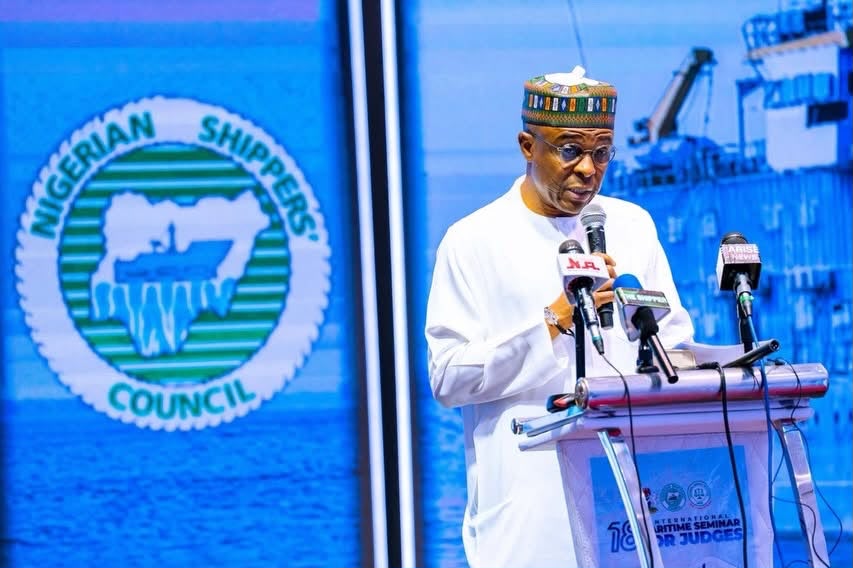
The Managing Director of the Nigerian Ports Authority (NPA), Dr. Abubakar Dantsoho, has said that a responsive and efficient maritime legal system is indispensable to the growth of international trade, stressing that prompt adjudication of maritime disputes is critical to strengthening investor confidence, facilitating commerce and enhancing Nigeria’s competitiveness in the global shipping industry.
Dantsoho stated this on Wednesday while participating in the 18th International Maritime Seminar for Judges held at the Ladi Kwali Hall of the Abuja Continental Hotel, Abuja.
The NPA Managing Director joined the Minister of Marine and Blue Economy, Adegboyega Oyetola, heads of agencies under the ministry, senior judicial officers, maritime stakeholders and members of the organised private sector at the annual seminar, which has become Nigeria’s foremost platform for strengthening judicial capacity in maritime law and admiralty practice.
Speaking on the theme, “Advancing Maritime Justice: Strengthening Global Trade,” Dantsoho said the growing complexity of international shipping, port operations and cross-border commerce demands an effective judicial system capable of resolving maritime disputes fairly, professionally and within reasonable timelines.
According to him, maritime trade flourishes where investors and shipping operators have confidence that commercial disagreements will be resolved swiftly and predictably, noting that prolonged litigation increases the cost of doing business, disrupts supply chains and undermines trade competitiveness.
He described the judiciary as a strategic partner in Nigeria’s quest to build a modern, efficient and globally competitive maritime sector, commending the National Judicial Institute for sustaining specialised training that equips judges with the knowledge required to adjudicate increasingly sophisticated maritime and commercial cases.
The seminar comes against the backdrop of ongoing reforms being implemented by the Federal Government under President Bola Ahmed Tinubu’s Renewed Hope Agenda to reposition the marine and blue economy as a major contributor to national economic growth.
Earlier, the Minister of Marine and Blue Economy, Adegboyega Oyetola, declared that the Tinubu administration has fundamentally changed the trajectory of Nigeria’s maritime sector through far-reaching reforms aimed at modernising port infrastructure, digitalising port and shipping operations, improving the ease of doing business and strengthening the country’s position as a regional maritime hub.
Oyetola highlighted key initiatives including the implementation of the National Single Window project, automation of port processes, enhancement of maritime security, infrastructure renewal and measures designed to reduce cargo dwell time and logistics costs while boosting Nigeria’s participation in regional and global trade.
As the agency responsible for managing Nigeria’s seaports, the Nigerian Ports Authority occupies a central position in the implementation of these reforms.
Under Dantsoho’s leadership, the Authority has intensified efforts to improve operational efficiency across the nation’s ports through infrastructure rehabilitation, channel management, digital transformation, multimodal cargo evacuation, stakeholder collaboration and measures aimed at reducing vessel waiting time and improving port productivity.
Industry experts believe that while investments in infrastructure and technology are essential, the full benefits of the government’s maritime reforms can only be realised when complemented by a responsive legal framework that guarantees certainty, protects commercial rights and ensures speedy resolution of disputes.
The annual International Maritime Seminar for Judges continues to provide an important platform for strengthening Nigeria’s maritime jurisprudence and aligning the country’s legal framework with international best practices as global shipping and maritime commerce become increasingly complex