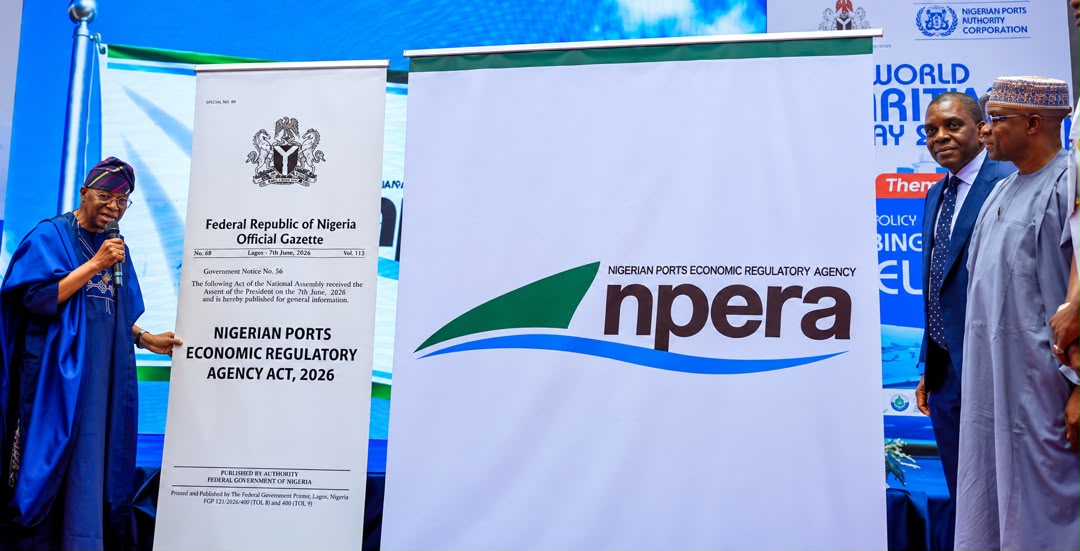
The Federal Government has unveiled the gazetted Nigeria Ports Economic Regulatory Agency (NPERA) Act, 2026, and the agency’s official logo, marking a new phase in Nigeria’s efforts to strengthen economic regulation of its ports and improve the competitiveness of the maritime sector.
The Minister of Marine and Blue Economy, Dr Adegboyega Oyetola, announced the development on Friday at the Third Quarter 2026 Citizens’ and Stakeholders’ Engagement of the Federal Ministry of Marine and Blue Economy in Victoria Island, Lagos.
The unveiling follows President Bola Ahmed Tinubu’s assent to the legislation in June 2026 and the transition of the Nigerian Shippers’ Council, which had served as the interim port economic regulator since 2014, into the new agency.
For Nigeria’s maritime industry, the legislation represents an important institutional development after years of efforts to establish a permanent statutory framework for port economic regulation. However, its ultimate significance will depend less on the creation of a new agency than on its ability to address longstanding concerns over port charges, service delivery, competition and the cost of doing business.
Oyetola said NPERA would regulate tariffs and charges, promote competition, enforce service standards, resolve commercial disputes and protect the interests of port users. He also disclosed that he had directed the immediate constitution of a ministerial committee to oversee the transition from the Shippers’ Council to the new agency.
“The credibility of an economic regulator rests, in no small measure, on its independence, impartiality and freedom from responsibilities that could give rise to actual or perceived conflicts of interest,” the minister said.
His emphasis on independence touches on one of the most consequential issues in the implementation of the new law. An economic regulator must be capable of scrutinising the conduct of terminal operators, shipping companies and other service providers without favour, while ensuring that the interests of port users are not subordinated to the commercial influence of powerful industry players.
The agency’s credibility will therefore depend on the clarity of its regulatory powers, the transparency of its decisions, the independence of its leadership and its willingness to enforce sanctions where violations are established. Its funding arrangements and governance structure will also be important in determining whether it can operate impartially.
The transition to NPERA is significant because the Nigerian Shippers’ Council had already performed several of these regulatory functions under its interim mandate. The Council was appointed interim port economic regulator in February 2014, following the restructuring of Nigeria’s port system and the concessioning of terminals to private operators.
The port concession programme transferred cargo-handling and terminal-management responsibilities to private companies, while the Nigerian Ports Authority retained its landlord-port functions and responsibilities for port infrastructure and related statutory obligations. The resulting system required an economic regulator capable of monitoring commercial practices, overseeing applicable tariffs and promoting fair competition.
The Shippers’ Council subsequently exercised responsibilities that included tariff monitoring, service standards, dispute resolution and the protection of shippers. The NPERA Act is intended to provide a more permanent statutory foundation for this function, but the industry will expect the new agency to demonstrate improvements beyond the administrative change.
For importers, exporters, manufacturers and freight forwarders, the most immediate test will be whether port operations become less expensive, more predictable and more efficient.
The cost of moving cargo through Nigerian ports extends beyond published terminal tariffs. Shipping and agency charges, storage, demurrage, container detention, documentation and cargo-handling expenses can significantly increase the cost of imports and exports. Delays in cargo release and evacuation can further tie down working capital, disrupt production schedules and weaken the competitiveness of Nigerian businesses.
NPERA will therefore need to establish a transparent framework for approved charges, provide accessible channels for complaints and publish clear procedures for resolving disputes. Regular disclosure of tariff decisions, enforcement actions and service-performance indicators would help port users understand their rights and assess the regulator’s effectiveness.
The objective should not be to suppress legitimate commercial charges, but to ensure that fees are lawful, transparent, proportionate to services rendered and consistent with fair competition. Where complaints involve unlawful charges or breaches of regulatory requirements, the agency must be able to investigate and enforce its decisions within the limits of its statutory powers.
The relationship between NPERA and other maritime institutions will also require careful management. While the new agency is expected to exercise economic oversight, the Nigerian Ports Authority retains its statutory responsibilities for port infrastructure, facilities and landlord-port operations. The distinction must be clear enough to prevent overlapping directives, duplicated charges and jurisdictional disputes.
The Nigeria Customs Service presents another important consideration. Its statutory responsibilities for customs control, revenue collection, enforcement and trade facilitation remain distinct from NPERA’s economic regulatory mandate. Effective coordination among the institutions will be essential to ensure that the new regulatory framework improves the operating environment rather than adds another layer of administrative complexity.
Beyond regulation, Oyetola reaffirmed the Federal Government’s commitment to modernising Apapa, Tin Can Island, Onne, Rivers, Delta and Calabar ports, insisting that no part of the national port system would be excluded from the programme.
He also disclosed that the government had approved the development of the Ibom, Bakassi, Agge, Gateway, Ondo and Bonny Deep Seaports, with the aim of expanding maritime capacity and strengthening Nigeria’s position as a regional logistics hub.
The proposed developments could widen the country’s port capacity, attract investment and create opportunities for coastal communities. However, the economic benefits will depend on the readiness of supporting infrastructure, the availability of financing, credible feasibility studies, environmental approvals and clear implementation schedules.
Government approval is only one stage in the development of a port. Financing, procurement, construction, road and rail connectivity, navigational access and cargo-generating economic activities are equally important in determining whether a project becomes commercially viable.
Nigeria’s existing ports continue to face challenges associated with road congestion, cargo evacuation, infrastructure constraints and the need for modern handling facilities. A credible modernisation programme must therefore be supported by measurable milestones showing which projects have secured funding, commenced construction or entered commercial operation.
The economic regulator also has a role to play in ensuring that investment in port infrastructure translates into better services and fairer commercial conditions for users. Increased capacity alone will not guarantee competitiveness if charges remain unpredictable or operational inefficiencies continue to impose additional costs on businesses.
On maritime security, Oyetola cited Nigeria’s record on piracy and the reported absence of piracy incidents in its territorial waters, attributing the progress to sustained interventions, including the Deep Blue Project.
He also highlighted the lifting of the United States Coast Guard’s 12-year Condition of Entry restrictions on vessels arriving in the United States from Nigeria in August 2026. The development followed a review of Nigeria’s port security arrangements and compliance with international maritime security requirements.
The decision represents an important recognition of progress in port security and could help strengthen confidence among international shipping interests. Nevertheless, sustaining the gains will require continued investment in intelligence, surveillance, port-facility security and cooperation among relevant agencies.
For the maritime industry, security improvements must be accompanied by progress in cargo handling, port access and commercial efficiency if Nigeria is to strengthen its position in international shipping and regional trade.
The minister also renewed the government’s commitment to indigenous shipping, disclosing that he had directed the Nigerian Maritime Administration and Safety Agency (NIMASA) to work with approved Primary Lending Institutions to accelerate the processing and disbursement of the Cabotage Vessel Financing Fund to qualified applicants.
The fund was established to support eligible Nigerian operators in acquiring vessels and developing domestic shipping capacity. Its effective utilisation has long been regarded as an important component of efforts to strengthen indigenous participation in the maritime sector.
Nigerian shipping companies face significant capital requirements in acquiring and maintaining vessels, meeting international safety standards and competing with established foreign operators. Access to affordable financing could help expand domestic fleets, improve local participation in coastal shipping and create employment for Nigerian seafarers.
However, the industry needs clear information on the fund’s implementation arrangements, application procedures, eligibility requirements, lending conditions and disbursement timelines. The government should also provide regular updates on the number of qualified operators supported, the vessels acquired and the capacity added to the indigenous fleet.
The minister’s announcement will be judged by whether it produces tangible improvements in Nigerian shipping capacity rather than another prolonged cycle of promises about access to finance.
Oyetola also cited Nigeria’s election to Category C of the International Maritime Organization Council in November 2025 and ongoing engagements with Denmark, India, Norway and the United Kingdom as evidence of the government’s commitment to international cooperation.
“Our approach to international cooperation is purposeful and results-oriented,” he said, stressing that partnerships should strengthen local capabilities and deliver measurable, sustainable outcomes.
The Danish Ambassador to Nigeria, Jens Ole Bach Hansen, who delivered a presentation on Denmark’s experience in building a sustainable blue economy, pledged his country’s continued partnership with Nigeria in developing the sector.
The engagement highlighted opportunities for cooperation in maritime technology, green shipping, digitalisation, port management and skills development. Denmark’s experience could offer useful lessons, but the value of such partnerships will depend on the extent to which they translate into local investment, technology transfer and stronger Nigerian technical capabilities.
For Nigeria, cooperation should go beyond diplomatic engagements, memoranda of understanding and investment announcements. It should support the development of local shipbuilding and repair capacity, improve maritime training, strengthen fisheries management and contribute to the control of pollution in coastal areas and inland waterways.
These challenges underline the wider responsibilities of the Ministry of Marine and Blue Economy. Port regulation is an essential component of maritime development, but the blue economy also encompasses fisheries, aquaculture, coastal livelihoods, marine environmental protection, inland-waterway transport and the development of indigenous maritime expertise.
Progress in these areas will require sustained funding, effective coordination among agencies and clear performance targets. International partnerships should be evaluated against the practical benefits they deliver to Nigerian businesses, workers and coastal communities.
The unveiling of the NPERA Act, 2026, is therefore an important step in the institutional development of Nigeria’s maritime sector, but it also raises expectations that the new regulator will deliver improvements that port users can see and measure.
The agency’s performance should be assessed against concrete indicators, including tariff transparency, the speed of dispute resolution, compliance with service standards, the treatment of complaints and the enforcement of regulatory decisions. Periodic reporting on these indicators would help establish accountability and enable stakeholders to determine whether the new framework is making a meaningful difference.
Ultimately, Nigeria’s maritime competitiveness will not be determined by legislation alone. It will depend on whether the law is implemented consistently, whether regulatory institutions respect their respective mandates and whether investments in ports, shipping and maritime infrastructure produce measurable economic benefits.
For NPERA, the challenge is to demonstrate that statutory status brings stronger and more effective regulation. For the government, the broader task is to ensure that the reform contributes to lower trade costs, stronger indigenous shipping, improved port services and a maritime economy capable of supporting national development.