

By Okey IBEKE
For decades, Nigeria’s quest for economic diversification has followed a familiar cycle of ambition and disappointment. Successive administrations have promised to reduce dependence on crude oil by expanding manufacturing and promoting non-oil exports, yet every downturn in global oil prices has exposed the same structural weaknesses—limited export capacity, high production costs, weak logistics and persistent pressure on foreign exchange earnings.
President Bola Ahmed Tinubu’s Renewed Hope Agenda seeks to break that cycle by placing industrialisation, investment and export expansion at the centre of economic policy. While public attention has focused on fiscal reforms, tax policy and infrastructure, a quieter transformation is taking place within the Nigeria Customs Service (NCS). Increasingly, Customs is evolving from a revenue-collecting agency into an institution that facilitates trade and supports economic growth.
That evolution could become one of the less celebrated but more significant reforms underpinning Nigeria’s export ambitions.
Countries that have successfully diversified their economies have done more than negotiate trade agreements. They have invested in efficient ports, modern customs administrations, digital trade systems and institutions capable of moving goods across borders quickly, predictably and at competitive costs. Trade expands not simply because tariffs fall, but because delays, uncertainty and unnecessary bureaucracy are reduced.
That lesson is particularly relevant as Africa implements the African Continental Free Trade Area (AfCFTA), the world’s largest free trade area by participating countries. By creating a market of more than 1.4 billion people with a combined Gross Domestic Product exceeding US$3 trillion, AfCFTA presents Nigerian businesses with unprecedented opportunities to expand beyond the domestic market.
However, free trade agreements do not implement themselves. Preferential tariffs offer little advantage if exporters remain trapped by cumbersome documentation, inconsistent border procedures and lengthy cargo clearance. The success of AfCFTA will depend largely on efficient customs administrations capable of facilitating legitimate trade while safeguarding national borders.
Under the leadership of Comptroller-General Bashir Adewale Adeniyi, the Nigeria Customs Service has embarked on one of the most ambitious modernisation programmes in its history. The reforms encompass customs automation, risk-based cargo management, coordinated border administration, digital trade facilitation and stronger engagement with the private sector, all aimed at reducing the cost of doing business while improving compliance and border security.
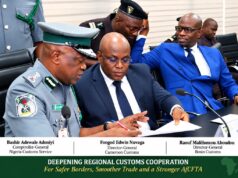
It was against this backdrop that the Service convened the inaugural Customs Partnership for African Cooperation in Trade (C-PACT) Summit in Abuja in November 2025.
C-PACT, Beyond Another Continental Conference
Africa has never lacked declarations on regional integration. Governments have signed numerous treaties and protocols intended to boost intra-African trade, yet implementation has often lagged behind political aspirations.
C-PACT sought to address that gap by focusing on the practical requirements for making AfCFTA work. Nearly 30 African customs administrations joined representatives of the World Customs Organization (WCO), the African Union, Afreximbank, development partners and the private sector to discuss digital customs systems, coordinated border management, Rules of Origin, intelligence sharing and customs interoperability—the operational issues that determine whether goods move across borders in hours or remain delayed for days or weeks.
The summit also underscored Nigeria’s growing influence in continental customs administration. Adeniyi’s election as Chairperson of the WCO Policy Commission had already elevated the country’s profile within the global customs community. Hosting C-PACT further positioned Nigeria not merely as an adopter of international standards but as a contributor to shaping Africa’s customs modernisation agenda.
More importantly, the summit produced practical outcomes. In the months that followed, the Nigeria Customs Service strengthened bilateral cooperation with customs administrations in countries including Benin Republic, Cameroon, Ghana, Côte d’Ivoire, Rwanda, Kenya, South Africa, Morocco and Zambia, while agreement with others are in progress. These partnerships promote information sharing, simplify documentation, improve verification of Rules of Origin and strengthen mutual administrative assistance—all essential ingredients for effective implementation of AfCFTA.
Digital Customs for a Digital Economy
Diplomatic cooperation alone, however, is insufficient without compatible digital infrastructure. While the C-PACT Summit underscored the importance of collaboration among African customs administrations, it also highlighted the need for a common technological framework capable of supporting the ambitions of the African Continental Free Trade Area.
A major outcome of the summit was the commitment to deepen cooperation on Trade Modernisation Regulations (TMR), which provide the legal and operational framework for harmonising customs procedures and promoting interoperability among customs management systems across Africa. The objective is to ensure that customs platforms in participating countries can securely exchange trade data, verify Rules of Origin, process declarations electronically and administer AfCFTA preferential tariff arrangements seamlessly.
For Nigeria, this objective is closely aligned with the deployment of the Unified Customs Management System (B’Odogwu). Developed by the Nigeria Customs Service as an indigenous digital customs platform, B’Odogwu is replacing the ageing Nigeria Integrated Customs Information System (NICIS II) with a more robust architecture that integrates cargo processing, valuation, compliance management, revenue collection, intelligence gathering and post-clearance audit into a single digital ecosystem.
Its significance extends well beyond domestic automation. Under the emerging Trade Modernisation Regulations, B’Odogwu system has been chosen to be interoperable management platform of AfCFTA for member states, enabling customs administrations to communicate electronically, authenticate trade documents, verify certificates of origin, exchange risk intelligence and process cargo using harmonised digital procedures.
Such interoperability represents one of the most important building blocks for implementing AfCFTA. A continental free trade agreement cannot function efficiently if customs administrations continue to operate as isolated national systems. The ability of customs platforms to communicate seamlessly will reduce delays at border crossings, minimise duplication of documentation, strengthen compliance, improve transparency and lower the cost of cross-border trade.
For Nigerian exporters, the implications are significant. Instead of repeatedly submitting the same documentation at different borders, traders will increasingly benefit from electronic processing, faster cargo clearance, improved predictability and reduced transaction costs. Digital integration will also strengthen confidence among customs administrations, making it easier to administer preferential tariff concessions and combat fraud without creating unnecessary obstacles to legitimate trade.
The platform equally enhances Customs’ enforcement capability. By relying on intelligence-led risk management, electronic profiling and real-time data analytics, B’Odogwu enables officers to focus physical inspections on genuinely high-risk consignments while facilitating the movement of compliant cargo. This strikes the delicate balance between trade facilitation and border security that characterises modern customs administration.
The significance of B’Odogwu therefore lies not merely in replacing an outdated software platform but in positioning Nigeria as a key participant in Africa’s emerging digital trade ecosystem. As more African customs administrations modernise their systems and adopt interoperable standards, Nigeria stands to benefit from faster trade flows, improved compliance and greater integration into continental value chains.
The impact of these reforms is already beginning to emerge. Between January and May 2026, the Nigeria Customs Service processed 21,376 export containers with a Free on Board (FOB) value of approximately US$1.218 billion. During the first quarter of the year, exports processed by the Service reached US$925.84 million, representing an increase of almost 39 per cent over the corresponding period in 2025, while export container throughput rose by nearly 96 per cent.
These figures represent far more than customs statistics. They reflect increased activity across agriculture, manufacturing, logistics, finance and transportation while indicating that efforts to reduce administrative bottlenecks are beginning to improve Nigeria’s export competitiveness. Although manufacturers continue to grapple with high energy costs, inadequate infrastructure, foreign exchange constraints and expensive financing, customs reforms are steadily removing some of the procedural barriers that have historically weakened the country’s export performance.
The Broader Economic Dividend
Ultimately, export growth is not measured simply by the number of containers leaving Nigerian ports or the value of goods processed by Customs. Every export consignment sets off a chain of economic activities that extends well beyond the ports. Farmers produce the raw materials, manufacturers process and package them, transport companies move them to export terminals, freight forwarders coordinate shipments, banks provide trade finance, insurers underwrite risks, while warehouses, logistics providers and terminal operators all benefit from increased commercial activity.
This multiplier effect explains why export-led economies tend to generate more sustainable growth than those driven primarily by commodity exports. Increased non-oil exports expand industrial production, create jobs, attract investment, deepen local value addition and generate much-needed foreign exchange. They also strengthen the naira over time by diversifying the country’s export earnings and reducing excessive dependence on crude oil revenues.
For Nigeria, therefore, improving customs efficiency is no longer simply a trade facilitation exercise. It is an economic development strategy. Every reduction in cargo clearance time, every improvement in border efficiency and every digital innovation that lowers the cost of doing business enhances the competitiveness of Nigerian products in regional and global markets. In an increasingly integrated African economy, efficient customs administration has become as important to export competitiveness as good roads, reliable electricity and access to affordable finance.
Successful export economies are rarely built on a single reform. Rather, they emerge when industrial policy, infrastructure development, macroeconomic stability and efficient trade facilitation reinforce one another. Customs modernisation is therefore not a substitute for broader economic reforms, but an essential complement to them.
Ironically, Nigeria’s improving export performance is exposing a new challenge. For years, shipping lines departed Nigerian ports with large numbers of empty containers because export cargo was insufficient. Today, exporters increasingly complain of limited vessel space as agricultural commodities, manufactured goods and processed products compete for available shipping capacity.
The reported backlog of more than 1,800 export containers at Lagos ports illustrates this emerging pressure on shipping services, port infrastructure and inland logistics. It is a reminder that trade facilitation does not end at customs clearance. Sustaining export growth will require continued investment in ports, multimodal transport, the National Single Window Project and modern logistics infrastructure.
History suggests that economic transformation is rarely achieved through grand declarations alone. More often, it is driven by institutions that quietly become more efficient, predictable and responsive to the needs of businesses and investors.
The Nigeria Customs Service cannot industrialise the country on its own. It cannot solve Nigeria’s energy deficit, build highways or lower interest rates. But it can remove many of the administrative and procedural barriers that have long constrained Nigerian businesses from competing successfully in regional and international markets.
That is the broader significance of the C-PACT initiative. It is not merely another customs conference or a showcase for digital technology. It represents a deliberate attempt to align Nigeria’s customs administration with the realities of twenty-first century commerce—where trade is increasingly digital, border procedures are intelligence-driven and customs administrations cooperate across national boundaries rather than operate in isolation.
The convergence of C-PACT, the Trade Modernisation Regulations (TMR), B’Odogwu’s interoperable digital architecture and the opportunities created by AfCFTA presents Nigeria with perhaps its best opportunity in decades to reposition itself as a leading trading nation in Africa. Whether that opportunity is fully realised will depend not only on Customs, but also on sustained investments in ports, transport infrastructure, manufacturing, energy, export financing and policy consistency.
If these reforms are sustained, they will be remembered not simply for modernising the Nigeria Customs Service or increasing government revenue, but for helping to build the institutional foundation of a diversified, export-driven economy. That would represent one of the most enduring contributions of the Tinubu administration’s Renewed Hope Agenda to Nigeria’s long-term economic transformation.
Okey IBEKE is the Principal Consultant, International Trade Advisory Services Ltd.