
By Okey IBEKE
The push for the establishment of a Nigerian Coast Guard has entered another critical phase, with proponents intensifying their campaign for legislative approval while the Nigerian Navy, sections of the National Assembly and other stakeholders continue to raise questions over duplication of functions, funding, operational jurisdiction and the wisdom of creating another maritime security institution.
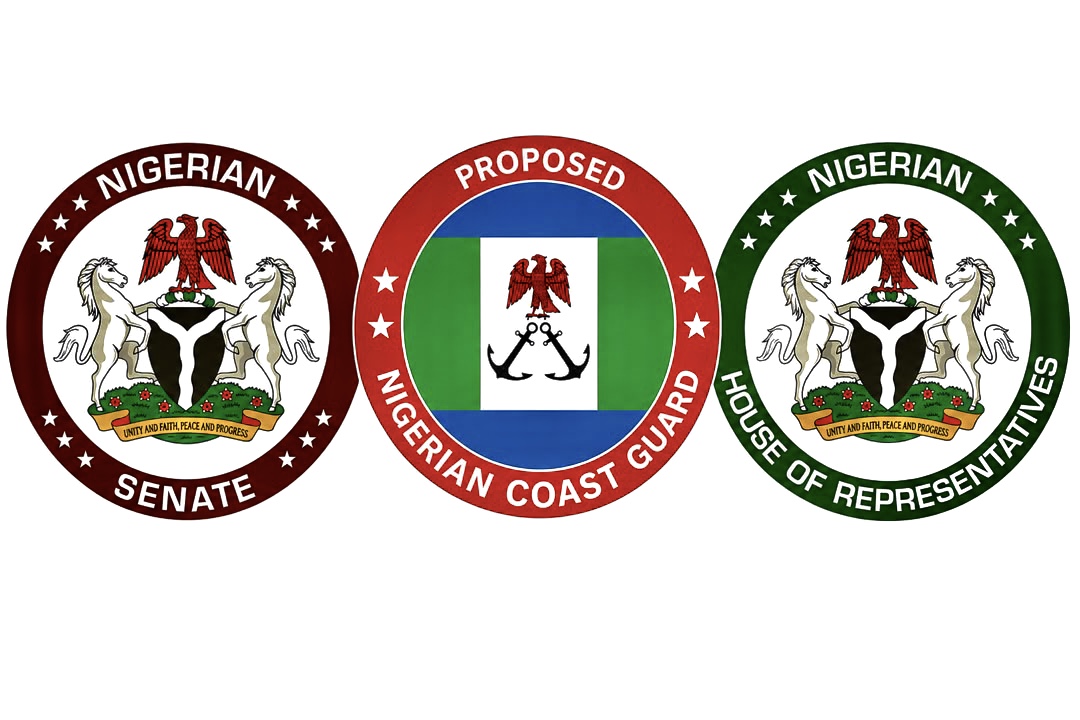
The latest push has come from the Provisional Committee for the Establishment of the Nigerian Coast Guard (PC-NCG), which has urged the Senate to pass the Nigerian Coast Guard Establishment Bill, arguing that Nigeria can no longer afford delays in addressing what it describes as gaps in maritime law enforcement, coastal security and ocean governance.
The committee’s renewed campaign has, however, run into a legislative roadblock.
The bill, which had reached the Senate’s third-reading stage, was stepped down for further consideration amid concerns over the duplication of responsibilities with the Nigerian Navy and other maritime agencies, as well as the financial implications of establishing and sustaining a new security organisation.
The development captures the central contradiction that has surrounded the Coast Guard proposal for years: while its promoters see it as a missing component in Nigeria’s maritime security architecture, its opponents see it as a potentially expensive duplication of institutions whose mandates already cover most of the functions assigned to the proposed agency.
For the proponents, the argument is straightforward. Nigeria has an extensive coastline, territorial waters, an Exclusive Economic Zone, thousands of kilometres of inland waterways and a growing Blue Economy ambition. They believe that the country’s maritime resources require a specialised civilian-led enforcement agency capable of dealing with search and rescue, fisheries protection, pollution control, maritime law enforcement and other responsibilities that are not necessarily military in character.
For the Nigerian Navy, however, the issue is more complicated.
A campaign that refuses to go away
The PC-NCG has maintained that Nigeria needs a dedicated Coast Guard to close institutional gaps in maritime security and governance.
In a statement issued by its Director of Communication and Public Affairs, Dr Piriye Kiyaramo, the committee’s Chief Executive and Accounting Officer, Noah Ichaba, said Nigeria could no longer afford further delays.
“What is required now is the political will to move from recognition to resolution, and from debate to decision,” Ichaba said.
He argued that the absence of a dedicated Coast Guard had contributed to overlapping mandates, fragmented funding and limited operational capacity.
According to him, a statutory Coast Guard would provide a dedicated civilian-led agency for search and rescue, fisheries protection, pollution control and maritime law enforcement, particularly across Nigeria’s territorial waters and Exclusive Economic Zone.
The committee also believes that improved maritime security would create a safer environment for investments in shipping, ports, aquaculture, offshore energy and coastal tourism.
The argument is closely tied to the Federal Government’s growing emphasis on the Blue Economy as a source of investment, employment and economic diversification.
The proponents therefore see the Coast Guard not simply as another security agency, but as an economic institution capable of protecting the marine environment and creating the conditions for greater utilisation of Nigeria’s maritime resources.
The Navy’s long-standing objection
But the campaign has encountered its most formidable opposition from the Nigerian Navy.
The Navy has consistently questioned the need for a separate Coast Guard, arguing that many of the proposed functions already fall within the responsibilities of existing maritime institutions, particularly the Navy.
At a public hearing on the Coast Guard proposal, representatives of the Navy raised concerns about duplication, funding, command structure and national security.
The Navy’s argument is rooted partly in Nigeria’s security realities. The country’s maritime domain is not simply a commercial space; it is also a strategic security environment involving offshore oil and gas installations, shipping lanes, piracy, illegal bunkering, oil theft, arms trafficking and other threats.
From the Navy’s perspective, introducing another armed or semi-armed maritime organisation could complicate command and control, particularly during security emergencies.
The Navy has also argued that Nigeria’s limited financial resources would be better used to strengthen its existing fleet, surveillance capabilities, personnel and logistics rather than establish an entirely new institution.
This is a significant reason for objection. A Coast Guard would require vessels, aircraft, surveillance equipment, communication systems, training facilities, bases and personnel. Beyond the initial capital expenditure, the government would have to provide annual funding for salaries, maintenance, fuel, training and operations.
The question therefore becomes whether Nigeria has the fiscal capacity to sustain another large maritime security organisation without weakening existing institutions.
The argument over duplication
The duplication argument extends beyond the Navy. Nigeria already operates a complex network of maritime institutions, including the Nigerian Maritime Administration and Safety Agency (NIMASA), Nigerian Ports Authority (NPA), Nigerian Shippers’ Council, Marine Police, Nigeria Customs Marine Commands and other agencies with regulatory, safety, security and enforcement responsibilities.
The existence of these institutions has made the Coast Guard debate particularly contentious. Critics argue that instead of creating another agency, government should strengthen existing institutions, eliminate overlapping mandates and improve coordination.
There is also concern that institutional rivalry could emerge over jurisdiction, intelligence, arrests, prosecution and control of maritime operations.
The proponents counter that the problem is precisely the absence of a specialised Coast Guard capable of bringing several civilian maritime enforcement responsibilities under one operational structure.
That argument has received support from some maritime stakeholders who believe the Navy should concentrate on military and national defence responsibilities while a Coast Guard handles civilian maritime safety and law enforcement.
The distinction is important. A modern Coast Guard in many countries performs functions that are different from conventional naval warfare. Search and rescue, fisheries enforcement, environmental protection, pollution response, maritime safety and certain law-enforcement duties require specialised capabilities that are not necessarily military.
But the Nigerian situation is complicated by the nature of maritime insecurity, where the boundaries between economic crime, organised crime and national security threats can quickly disappear.
A legislative roadblock
The Senate’s decision to step down the bill therefore represents more than a procedural delay. It exposes unresolved questions at the heart of the proposal.
The bill had progressed significantly through the legislative process before concerns over funding and duplication prompted further scrutiny.
Rather than proceeding to enactment, lawmakers have signalled the need for additional consultations.
That has provided opponents another opportunity to question whether the proposed Coast Guard is necessary and proponents another opportunity to explain how it would complement existing institutions.
The Senate is now faced with the difficult task of determining whether the proposal requires modification, stronger safeguards or outright rejection.
The legislative impasse also demonstrates that the Coast Guard campaign has not yet overcome its most fundamental challenge: convincing policymakers that the benefits of creating a new institution would outweigh the financial and institutional costs.
Beyond the Navy
Opposition to the proposal has not been confined to serving naval authorities.
Some retired senior naval officers, lawmakers and civil society organisations have also raised objections. Their concerns include the constitutional implications of creating another security institution, particularly if the proposed Coast Guard is given military characteristics.
Nigeria’s 1999 Constitution recognises the Nigerian Army, Navy and Air Force as the Armed Forces of the Federation. Consequently, questions have been raised about whether a Coast Guard established as another armed military organisation would require constitutional considerations beyond an ordinary enabling law.
Civil society groups have consequently advocated strengthening existing institutions and, if necessary, creating a civilian maritime agency with clearly defined responsibilities rather than another military force.
The debate has thus become more complicated than the original proposition of establishing a Coast Guard.
The Blue Economy argument
Yet, the proponents have a powerful economic argument. Nigeria’s coastline and maritime resources remain underutilised compared with their potential.
Shipping, ports, fisheries, aquaculture, offshore energy, marine tourism, shipbuilding, marine services and coastal trade could contribute substantially to economic diversification if the environment is secure and properly regulated.
Supporters argue that maritime insecurity imposes hidden costs on businesses and communities.
Piracy increases insurance and operating costs. Illegal fishing deprives legitimate fishermen and the government of revenue. Pollution damages marine ecosystems and coastal livelihoods. Smuggling undermines legitimate trade, while inadequate search-and-rescue capacity puts lives at risk.
A specialised Coast Guard, proponents believe, could address many of these challenges more effectively. They argue that transferring civilian maritime enforcement functions from the Navy to a dedicated Coast Guard could free the Navy to concentrate on its core military responsibilities. In that sense, they insist that the proposed agency should not be viewed as a competitor to the Navy but as a complementary institution.
The real question: what does Nigeria need?
This is where the debate requires a more sober examination. There is little dispute that Nigeria’s maritime domain requires stronger security, better surveillance, more effective enforcement and improved coordination. The disagreement is about the institutional mechanism for achieving those objectives.
The country has repeatedly responded to governance challenges by creating new agencies. But experience has shown that creating an agency does not automatically create capacity. Without funding, equipment, competent personnel, effective leadership, clear mandates and political accountability, a new Coast Guard could eventually face the same limitations confronting some existing institutions.
Conversely, simply rejecting the Coast Guard proposal without addressing identified gaps in maritime safety and law enforcement would also leave important questions unresolved.
The Senate therefore has an opportunity to move the debate beyond institutional rivalry. If the bill is to survive, it may need a clearer delineation of responsibilities between the Coast Guard, Navy, NIMASA, NPA, Marine Police and other relevant institutions.
There must also be clarity on whether the Coast Guard would be civilian or military, who would command it, what weapons and enforcement powers it would possess, how it would be funded and how it would operate during national security emergencies.
A comprehensive cost-benefit analysis would also be necessary.
A debate bigger than the bill
The continuing push for a Coast Guard demonstrates that the idea has acquired a life of its own in Nigeria’s maritime policy debate.
Its proponents believe it represents institutional reform that can strengthen security and unlock the Blue Economy, while its opponents believe the country risks creating another layer of bureaucracy and competition for scarce resources.
Between these two positions lies the real challenge: designing a maritime security architecture that is efficient, properly funded and capable of responding to both conventional security threats and the everyday safety and economic needs of Nigerians who depend on the sea.
The Senate’s legislative roadblock may therefore be an opportunity rather than an obstacle. Rather than rushing the bill through because of political pressure, or killing it because of institutional opposition, lawmakers could use the present pause to undertake a comprehensive review of Nigeria’s maritime security architecture.
The question should not simply be whether Nigeria should have a Coast Guard. It should be whether the proposed Coast Guard would make Nigeria’s maritime domain safer, more productive and better governed—and whether the country can afford to build and sustain it without weakening the institutions already charged with protecting its waters.
Until those questions are convincingly answered, the Coast Guard Bill is likely to remain caught between an increasingly persistent campaign for its passage and equally persistent opposition from powerful institutions.
For now, the Senate’s pause has created another chapter in a debate that has refused to disappear
Mr Okey IBEKE is the Editor in Chief, Business and Maritime West Africa