
By Okey IBEKE
For decades, the battle against smuggling in Nigerian seaports was largely associated with familiar commodities — rice, vegetable oil, frozen poultry, used clothing, vehicles and other prohibited or restricted imports. These goods still feature prominently in the enforcement activities of the Nigeria Customs Service, but seizure records emerging from the country’s seaports over the past four years point to a significant change in the nature of the threat.
Apart from confronting multifaceted cases of non-compliance with extant rules, Customs officers are opening containers carrying millions of tablets of tramadol and codeine, tonnes of cannabis, cocaine, counterfeit and expired medicines, rifles and ammunition. The transformation is significant because these are no longer simply cases of trade violations or attempts to evade import duties. They touch directly on public health, national security and the integrity of Nigeria’s economy.
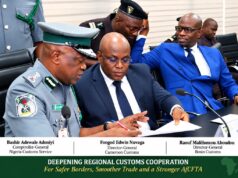
The change also coincides with a period of substantial reform within the Nigeria Customs Service under Comptroller-General Bashir Adewale Adeniyi and President Bola Ahmed Tinubu’s broader economic reform programme.
Since Adeniyi assumed leadership of the Service in 2023, Customs has placed greater emphasis on intelligence-led enforcement, risk management, digitalisation, inter-agency cooperation and trade facilitation. These reforms are occurring against the backdrop of the President’s Renewed Hope agenda, which seeks to strengthen government revenue, improve the business environment, support domestic production and expand Nigeria’s participation in regional and international trade.
The seizure records provide an important, if imperfect, window into how these objectives are coming together at the country’s maritime gateways.
In 2023, conventional prohibited imports remained a major part of port enforcement. Apapa reported 42 seizures worth about ₦1.4 billion in the first half of the year, while Tin Can Island recorded 47 seizures with a declared value of about ₦3.1 billion. But among the seizures were consignments that revealed a more dangerous dimension of the trade.
At Apapa, Customs intercepted approximately 144 million tablets of tramadol in one consignment, with an estimated value of more than ₦21 billion. Tin Can Island also recorded seizures involving tramadol and codeine.
By 2024, the pattern had become more pronounced. Onne emerged as a major enforcement theatre, with dozens of containers intercepted during the year. The consignments included large quantities of codeine, tramadol and other counterfeit pharmaceutical products. At Tin Can Island, Customs intercepted arms, ammunition and narcotics, while Apapa recorded seizures involving pharmaceuticals and other prohibited cargo.
The trend continued into 2025 and has become even more striking in 2026. Apapa recorded 53 container seizures in 2025 with a combined declared value of about ₦38.7 billion. At Onne, 75 containers of illicit goods were reportedly seized, with a declared value of approximately ₦47.6 billion. PTML also recorded a major cocaine seizure valued at about ₦29.4 billion.
But the most recent seizures demonstrate why the changing character of maritime smuggling deserves closer attention.
At the Tin Can Island Port, Customs intercepted a container containing 399 fully assembled pump-action rifles, alongside 535 firearm components. The shipment was identified through the Service’s risk-management and intelligence processes before the weapons could enter the domestic market. The seizure is considerably more consequential than the conventional image of smuggling as an attempt to circumvent import restrictions or avoid payment of duties. These were weapons capable of finding their way into the hands of criminal networks in a country already battling terrorism, banditry, kidnapping and other violent crimes.
At Apapa, Customs also intercepted a major consignment of Canadian Loud, with more than four tonnes of the cannabis strain seized in one operation and an estimated value running into tens of billions of naira. Other recent operations produced substantial quantities of cannabis, expired and prohibited pharmaceutical products and cannabis-infused items.
In another significant development, Customs handed over hard drugs and pharmaceutical products worth about ₦53.39 billion to the National Drug Law Enforcement Agency and NAFDAC. The handover included narcotics and dangerous pharmaceutical products intercepted at the ports and other points of entry. The significance of such seizures cannot be adequately captured by their monetary value. Their real value lies in the potentially harmful products that never reached consumers.
Onne has provided perhaps the clearest illustration of the scale of the pharmaceutical and opioid threat. Recent operations there uncovered containers containing millions of opioid tablets and millions of bottles of codeine syrup. Such quantities indicate that maritime smuggling is no longer simply the work of individuals attempting to bring restricted goods into the country. The scale points to organised networks with financing, international supply chains, logistics and intended distribution channels within Nigeria.
This is where the evolution of Customs enforcement becomes particularly important.
A seizure of illegally imported rice can undermine domestic agriculture, distort the market and deprive government of revenue. A container carrying millions of tablets of controlled drugs presents a different level of danger. A container containing hundreds of rifles presents an even more direct threat to national security.
The public-health consequences of such seizures are often overlooked because attention tends to focus on the monetary value of the goods. Yet the real significance of stopping a large counterfeit pharmaceutical or narcotics consignment is the number of people who may never encounter those substances.
The danger is particularly acute where counterfeit, substandard, unregistered or expired medicines are involved. Nigeria’s pharmaceutical supply chain extends from major urban centres to communities where consumers may have limited capacity to distinguish legitimate products from dangerous ones. Once such products leave the port and enter the distribution system, tracing them becomes considerably more difficult.
A seizure at the port therefore represents an opportunity to stop the problem before it reaches the consumer.
The same argument applies to narcotics. Every consignment of codeine, tramadol, cocaine or cannabis intercepted before distribution removes a potential source of drug abuse from the market. The impact cannot easily be expressed in Customs’ traditional language of Duty Paid Value.
There is an equally serious national-security dimension to the interception of firearms and ammunition.
A rifle stopped at the port is not simply another prohibited import removed from circulation. It is potentially a weapon that will not reach a criminal network. In a country already confronting terrorism, banditry, kidnapping and other forms of violent crime, preventing illicit firearms from entering the country is an important part of border security.
This is where the evolution of Customs enforcement under Adeniyi becomes particularly relevant.
Nigeria’s enormous trade volume makes it impossible to rely on physical inspection of every container. Such an approach would slow legitimate commerce, increase the cost of doing business and undermine the efficiency of the ports.
The alternative is risk-based enforcement — using intelligence, technology, cargo information and cooperation with other agencies to determine which consignments deserve closer scrutiny.
This approach is consistent with the wider modernisation programme being pursued by Customs.
The deployment of B’Odogwu, the Service’s digital Customs platform, is part of this transformation. The objective is to automate processes, improve transparency, reduce unnecessary human intervention and strengthen the ability of Customs to manage cargo according to risk.
Digitalisation therefore has implications beyond faster clearance. The more information available to Customs about a shipment, its declaration, its origin, its destination and its risk profile, the greater the ability to identify suspicious cargo without subjecting legitimate traders to unnecessary delays.
This is an important distinction in the debate about Customs enforcement. Trade facilitation and anti-smuggling are not opposing objectives. They should reinforce each other.
A legitimate importer wants his cargo cleared quickly and predictably. Customs wants to concentrate its resources on the cargo most likely to violate the law. A modern risk-management system makes both possible.
This is particularly important to President Tinubu’s Renewed Hope economic agenda.
The government’s economic reforms depend on a more productive private sector, increased investment, stronger domestic manufacturing, higher non-oil exports and greater participation in the African Continental Free Trade Area. None of these objectives can be achieved efficiently if Nigeria’s ports are either too difficult for legitimate traders to use or too vulnerable to illicit trade.
Customs is therefore operating at the intersection of economic growth and border protection. Its revenue function is important, but so is its responsibility to protect the integrity of the market.
When prohibited or undervalued goods are stopped at the port, legitimate businesses are protected from unfair competition. A manufacturer that pays taxes, complies with regulations and invests in Nigeria should not have to compete against an importer who evades duties or deliberately misdeclares cargo.
The same principle applies to pharmaceutical companies and other regulated industries whose legitimate products can be displaced by counterfeit or illicit alternatives. In that sense, anti-smuggling enforcement supports industrial policy as well as revenue collection.
There is also a connection with Nigeria’s ambitions under AfCFTA. A country seeking to become a major manufacturing and distribution hub in Africa needs efficient and credible trade gateways. Its Customs system must be able to distinguish between legitimate commerce and illicit trade without turning every shipment into a bureaucratic obstacle.
That is the balance Adeniyi’s reforms must continue to pursue: a Customs Service that is increasingly difficult for smugglers to penetrate but easier for legitimate traders to deal with.
The seizures also demonstrate the importance of inter-agency cooperation. Customs may be the agency that detects and intercepts a suspicious container, but narcotics, pharmaceuticals and firearms often require the expertise and statutory responsibilities of agencies such as the National Drug Law Enforcement Agency, NAFDAC and other security institutions.
The recent handovers of seized narcotics and pharmaceutical products illustrate why this cooperation matters. Customs’ responsibility does not end with opening a container and identifying its contents. The enforcement chain must continue through investigation, evidence gathering, prosecution, intelligence development and, where appropriate, the destruction or lawful disposal of dangerous goods.
The effectiveness of the system therefore depends not only on interception but on what follows it — investigation, prosecution, intelligence development and the dismantling of the networks behind the cargo.
That is perhaps the next challenge for Nigerian enforcement. The seizure of a container is important, but the people behind the container are more important.
Who financed the shipment? Who supplied the goods? Who arranged their movement? Who was expected to receive them? How many similar consignments have already entered the country?
These questions determine whether a seizure is merely an isolated enforcement success or part of a broader effort to disrupt organised smuggling.
There is also a danger in measuring Customs performance exclusively by the number or value of seizures. A rise in seizures can indicate stronger enforcement, but it can also reflect a rise in attempted smuggling. Conversely, fewer seizures may indicate improved compliance if traders are increasingly deterred from violating the rules.
The more meaningful measure is whether the system is becoming more effective at identifying risk, facilitating legitimate commerce and preventing illicit goods from reaching the Nigerian market. That is ultimately what makes the seizures of the past four years significant.
They show a Customs Service dealing with a more sophisticated and potentially more dangerous form of maritime smuggling while simultaneously being asked to support economic growth.
The challenge is substantial. Nigeria wants its ports to move cargo faster, reduce trade costs and support exports, while ensuring that the same ports do not become convenient entry points for narcotics, firearms, counterfeit medicines and other dangerous goods.
The answer cannot be more bureaucracy. It must be better intelligence, better technology, better risk management and stronger cooperation among enforcement agencies.
Under Adeniyi, the Nigeria Customs Service has been moving in that direction.
The results are visible in the containers being intercepted — from traditional prohibited imports to increasingly sophisticated consignments of drugs, pharmaceuticals and firearms. The recent interception of 399 rifles is particularly instructive because it demonstrates how economic border enforcement can quickly become an exercise in national security.
But the real impact of those seizures extends far beyond the ports. They protect legitimate businesses from unfair competition, protect government revenue, shield consumers from dangerous products and help prevent illicit weapons and narcotics from entering Nigerian communities.
That makes Customs enforcement part of the country’s economic recovery effort rather than a separate activity from it.
The Renewed Hope agenda requires institutions capable of enforcing the rules on which economic reform depends. Customs is one of those institutions.
Its task is not simply to collect revenue or seize contraband. It is to create a border environment in which legitimate trade can flourish while illegal trade becomes increasingly difficult.
The evolution from used clothing to rifles captures that challenge.
The used clothing represents the traditional face of smuggling — prohibited goods, revenue leakage and unfair competition. The rifles, narcotics and dangerous pharmaceuticals represent the new frontier — organised crime, public-health risks and national security.
Nigeria needs Customs to confront both.
And the ultimate measure of success may not be the number of seized containers displayed before the cameras, but whether the country is becoming a place where legitimate cargo moves more freely, businesses compete more fairly, government collects what is due and dangerous goods increasingly fail to make it beyond the port.
Okey IBEKE is the Principal Consultant, International Trade Advisory Services Ltd