By Okey IBEKE
Nigeria’s export ambitions are increasingly being shaped not only by what the country produces, but by how efficiently its goods can cross borders and enter foreign markets. That is bringing the Nigeria Customs Service into a role that extends beyond revenue collection and border enforcement. That role is trade diplomacy.
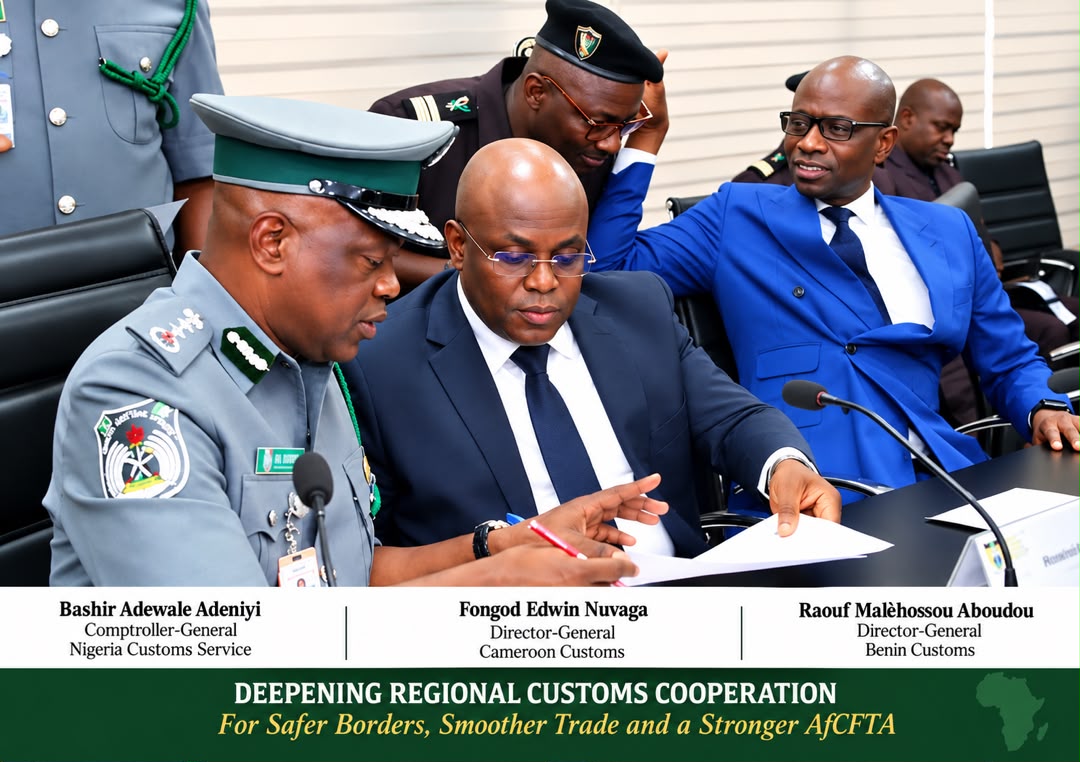
Under Comptroller-General Bashir Adewale Adeniyi, the Service has increasingly engaged foreign and neighbouring Customs administrations to align procedures, exchange information, strengthen enforcement and facilitate legitimate commerce. The significance of these engagements is not the meetings, memoranda or diplomatic exchanges themselves, but whether they help remove practical barriers between Nigerian producers and the markets they seek to reach.
That distinction matters as Nigeria does not lack trade agreements or export ambitions. What has often been missing is the operational machinery that converts those agreements into predictable movement of goods across borders. That is where Customs current trade diplomatic shuffling becomes crucial.
The Service’s growing engagement with Niger Republic, Benin Republic and Cameroon, alongside its wider international Customs relationships, therefore represents a broader shift in how Nigeria approaches trade. The border is being treated not merely as a line to be policed, but as a point at which trade competitiveness can either be strengthened or undermined.
That makes Customs diplomacy increasingly relevant to the country’s non-oil export drive and to the African Continental Free Trade Area, particularly as Nigeria seeks to expand its participation in regional and continental commerce.
There are already indications that the export base is expanding. The Nigerian Export Promotion Council reported that non-oil exports reached $6.1 billion in 2025, an 11.5 per cent increase from $5.46 billion in 2024. Export volume also rose from 7.29 million metric tonnes to 8.02 million metric tonnes. NEPC said the 2025 performance was the highest formally documented non-oil export value in Nigeria’s history.
Those figures cannot be attributed to Customs. Production, investment, standards, logistics, finance, infrastructure and international demand all determine export performance. But Customs remains positioned at a critical point between the Nigerian producer and the external market.
From Border to Trade Diplomacy
For much of its history, Customs was understood principally as an institution responsible for collecting revenue, controlling imports and protecting the country’s borders against smuggling. Those responsibilities remain fundamental, but the structure of international commerce has changed.
The Customs Service’s domestic reforms are part of that response. Its B’Odogwu trade platform is designed to simplify Customs processing and provide traders and licensed agents with more efficient access to digital services, while the National Single Window is being developed as a unified digital environment for trade and maritime documentation. The Service also operates the Authorised Economic Operator and Advance Ruling programmes as part of a broader push towards greater predictability and risk-based processing.
There is measurable evidence of institutional change. The NCS reported collecting ₦6.1 trillion in 2024, exceeding its revenue target by 20.2 per cent. It also reported that the value of trade processed rose to ₦196.94 trillion in 2024, compared with ₦70.50 trillion in 2023.
These figures are principally measures of Customs performance, not proof that export competitiveness has been solved. Their relevance is that a Customs administration capable of processing compliant trade more efficiently can reduce one layer of cost and uncertainty for businesses operating across borders. But domestic reform has an obvious limitation: Nigerian procedures cannot by themselves determine what happens on the other side of a border.
A Nigerian exporter may complete an electronic declaration in Nigeria only to encounter different documentation requirements, inspection procedures or information systems after crossing into another jurisdiction. That is where Customs diplomacy becomes commercially important.
Niger, Benin and Cameroon Engagements
The engagement with Niger Republic is significant because of the country’s dependence on regional transit routes. Recent discussions between the two Customs administrations have focused on streamlining documentation, removing bottlenecks and improving the movement of goods along corridors including Illela–Sokoto–Kamba–Niger Republic and routes linking Nigerian ports and airports with neighbouring countries. Nigerian Customs described the objective as reducing costs, increasing trade volumes and making the corridors more attractive to transport operators.
For Nigeria, the implications extend beyond Nigerien imports. Efficient transit through Nigerian ports and corridors can strengthen the country’s position as a regional logistics gateway while creating opportunities for transporters, freight forwarders, warehouses and other trade-support businesses.
The relationship with Benin Republic has a more direct bearing on the movement of goods between Nigeria and the wider West African market. The Seme-Krake corridor is one of the region’s important commercial gateways, and Nigerian Customs has repeatedly engaged its Beninese counterpart and other stakeholders over the removal of obstacles to legitimate cross-border trade. At the Seme-Krake Joint Border Post, Nigerian Customs has emphasised stronger cooperation with Benin Customs, particularly around trade facilitation and security along the Lagos-Abidjan corridor.
There is also a concrete indication of renewed export activity through the broader Nigeria-Benin corridor. The Ogun I Area Command of the service reported that it facilitated 20,972 metric tonnes of exports valued at about ₦1.049 billion FOB between April and June 2026, compared with no recorded export activity during the corresponding period of 2025. The exports included white talc, crushed thermal coal and compressed natural gas. The figure should not be mistaken for evidence of a transformation in Nigeria’s export economy. It is, however, a useful illustration of what a functioning land-border export channel can look like in practice.
The Benin relationship also demonstrates the other side of Customs cooperation: enforcement. Nigeria and Benin face a shared challenge from smuggling and other forms of illicit cross-border activity. Cooperation between the two administrations allows intelligence, surveillance and enforcement information to be shared while legitimate traders are separated, as far as possible, from high-risk movements.
That distinction is central to modern Customs administration. The objective is not simply to make borders more open or more restrictive. It is to make them more predictable for legitimate trade while making them more difficult for illicit commerce.
The Nigeria-Cameroon relationship adds another layer to the regional approach.
Nigeria, Benin and Cameroon have been examining coordinated border management, digital interoperability, harmonised procedures and risk management, while Nigerian Customs has identified Seme-Krake, Jibia-Maradi and Mfum-Ekok among the strategic border posts requiring modernisation and stronger trade infrastructure.
The commercial logic is straightforward. Duplicated procedures, inconsistent documentation and unnecessary delays add to the cost of moving goods and can weaken the competitiveness of Nigerian products in regional markets.
The Diplomacy and the AfCFTA Opportunity
The wider significance of these engagements becomes clearer within the African Continental Free Trade Area. AfCFTA provides the framework for a much larger African market, but trade agreements do not physically move goods. Businesses still have to navigate ports, roads, border posts and Customs procedures. This gives Customs administrations an important role in determining how much of the potential created by AfCFTA becomes actual trade.
For Nigeria, the stakes are considerable. The country has a large productive base and one of Africa’s biggest consumer markets, while the non-oil export sector is showing signs of expansion. The question is how effectively Nigerian businesses can convert that productive capacity into a stronger presence across African markets.
Closer operational relationships with neighbouring Customs administrations is key to the success of the efforts. Information-sharing arrangements can reduce disputes and strengthen enforcement. Compatible digital systems can limit duplication. Coordinated border management can make major regional corridors more predictable.
The same logic extends beyond Nigeria’s immediate neighbours. Engagement by the Comptroller-General with other Customs administrations and participation in international Customs forums provide opportunities to exchange technical knowledge, negotiate cooperation arrangements and understand the regulatory environments confronting Nigerian businesses in foreign markets.
This is where the diplomatic dimension becomes important. Customs cooperation is no longer simply about what happens at the Nigerian side of a border. It is increasingly about building relationships with the institutions that control what happens on the other side.
From Reform to Market Access
The real significance of B’Odogwu, the National Single Window, AEO, Advance Ruling and related reforms will ultimately depend on whether they make legitimate trade cheaper, faster and more predictable. The international dimension extends that objective beyond Nigeria’s borders.
If systems are compatible and Customs administrations can exchange reliable information, a consignment can move through a regional corridor with fewer points of uncertainty. If administrations cooperate on enforcement, they can better distinguish legitimate trade from illicit movements. Where transit arrangements are clear, Nigerian ports and transport corridors become more useful to neighbouring economies. These are practical commercial gains rather than abstract trade-policy objectives.
They also explain why the Customs Service’s engagements with Niger, Benin and Cameroon matter to Nigeria’s wider trade strategy. The three relationships involve different circumstances, but each connects Customs administration to a market or corridor with implications for regional commerce.
The Niger engagement is closely linked to transit and access to Nigerian routes. The Benin relationship centres heavily on the Seme-Krake gateway and the wider Lagos-Abidjan corridor. The Cameroon relationship brings the Mfum-Ekok corridor into a broader discussion about coordinated border management and regional connectivity.
Together, they point towards a Customs administration that is increasingly looking beyond the Nigerian side of the border.
The $6.1 billion non-oil export figure for 2025 provides a useful benchmark, but the more important question is what happens next.
Can Nigerian exporters reach more African markets? Can agricultural products move from production centres to foreign buyers without avoidable border delays? Can manufacturers use regional corridors with enough predictability to build long-term supply contracts? Can Nigeria’s ports and land borders become reliable components of continental supply chains?
These questions cannot be addressed by Customs alone. But they cannot be answered without Customs either. Production must be competitive. Standards must be met. Infrastructure and logistics must improve. Finance must be available. Power and transport costs must be addressed. Foreign buyers must be cultivated.
Customs occupies a different but essential part of that chain: ensuring that when a Nigerian product is ready for export, the border does not become the weakest link. That is why the Service’s growing international engagement deserves to be viewed through the lens of market access rather than diplomacy for its own sake.
The real test will not be the number of delegations received, agreements signed or technical meetings held. It will be whether those engagements produce faster and more predictable movement of legitimate cargo, stronger regional corridors and fewer operational barriers for Nigerian exporters. If that happens, Customs diplomacy will have translated institutional cooperation into development far more consequential. That development is an expanded access for Nigerian products to regional and global markets.
Nigeria’s export challenge is no longer simply about producing more goods. It is about building the systems, corridors and relationships that allow those goods to compete beyond Nigeria’s borders. The border, therefore, is no longer merely where Nigeria collects revenue or intercepts illicit trade. It is the gateway through which the country’s export ambitions must pass.