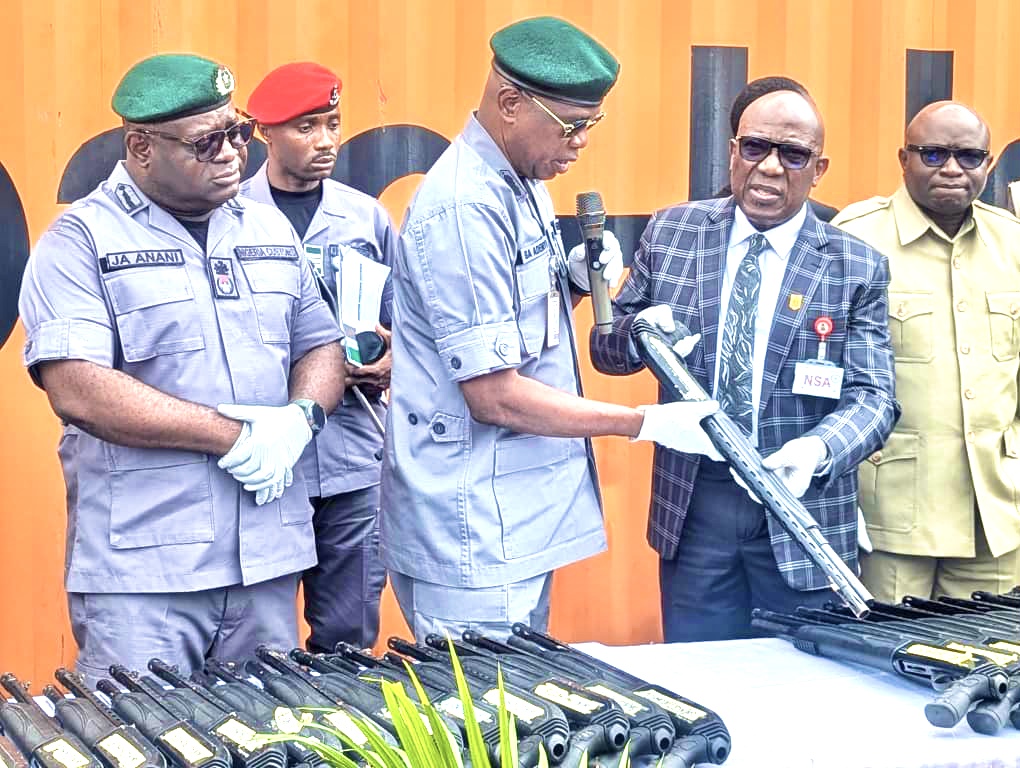
The Nigeria Customs Service (NCS) has handed over 399 seized rifles and a large quantity of firearm components to the National Centre for the Control of Small Arms and Light Weapons (NCCSALW), in a move aimed at ensuring proper custody, accountability and eventual disposal of the illicit weapons.
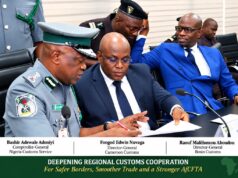
The Comptroller-General of Customs, Bashir Adewale Adeniyi, made the handover on Monday at the Tin Can Island Port in Lagos, where the consignment was intercepted during inspection and documentation.
Adeniyi said the seizure demonstrated the importance of strengthening security controls at Nigeria’s ports, particularly as criminal networks increasingly attempt to exploit legitimate channels of international trade to move prohibited items into the country.
According to him, the consignment contained 399 rifles, as well as 89 frames, 80 charging handles, 579 trigger groups and 25 locking lugs.
He said the Customs Service had completed the necessary inspection, documentation and enforcement procedures before transferring the seized items to the NCCSALW for further action.
“The service has completed inspection and documentation of the consignment intercepted at the port,” Adeniyi said.
He attributed the interception to the deployment of the Service’s trade modernisation system and improved risk-management tools, which, he explained, enable Customs officers to identify high-risk consignments without physically examining every container passing through the port.
“Technology has now made it possible for Customs personnel to identify high-risk containers without examining every shipment manually,” he said.
Two suspects allegedly connected with the consignment were arrested and subsequently remanded by a Federal High Court in Lagos, according to the Customs chief.
The development is significant because the discovery of firearm components in a commercial cargo environment highlights the continuing challenge of preventing the country’s international trade corridors from being exploited for arms trafficking.
For a country confronting terrorism, banditry, kidnapping, armed robbery and other forms of violent crime, the interception of weapons before they reach criminal networks is as important as the recovery of arms already in circulation.
The NCCSALW, which operates under the Office of the National Security Adviser (NSA), was established in May 2021 in line with Article 24 of the ECOWAS Convention on Small Arms and Light Weapons. Its mandate includes coordinating national efforts to control and prevent the proliferation of illicit small arms and light weapons. (NCC Salw)
The Centre has increasingly become the focal institution for the custody, profiling, management and destruction of recovered illicit weapons. In April 2026, it announced the destruction of another 2,800 illicit, obsolete, unserviceable and decommissioned weapons, bringing the number of weapons it said it had destroyed since its establishment to more than 16,000. (NCC Salw)
That process is important because recovered weapons cannot simply remain indefinitely in the custody of the enforcement agency that intercepted them. Proper documentation, secure storage, forensic profiling and eventual destruction or other lawful disposition are necessary to prevent seized weapons from being recycled into criminal circulation.
Receiving the weapons, the Director-General of the NCCSALW, Deputy Inspector-General of Police (rtd.) Johnson Babatunde Kokumo, commended the Customs Service for the seizure and for transferring the weapons to the Centre.
Kokumo said the Centre received 399 illicit weapons and the two suspects from the Customs Service, stressing that illicit arms proliferation remained a major security challenge because weapons provide the means for terrorists, bandits, kidnappers and other criminal groups to sustain violence.
He said more than 21,000 weapons had been retrieved by the Centre, while about 19,000 had been destroyed.
The Director-General said the weapons received from Customs had been catalogued, adding that the Centre would profile them and determine the appropriate course of action, including the destruction of unserviceable weapons.
He also referred to previous arms seizures at the Lagos airport and Onne Port, noting that investigations and prosecutions arising from such seizures remained part of the broader effort to disrupt the networks involved in illicit arms trafficking.
Kokumo called for greater cooperation among security and enforcement agencies, particularly in intelligence sharing, tracking of arms-trafficking networks and the management of recovered weapons.
His position reflects a growing recognition among security agencies that the fight against illicit arms cannot be won by seizures alone. Intelligence-led interdiction, border surveillance, financial investigation, prosecution and effective management of recovered weapons are all necessary to break the supply chain.
Nigeria’s geographical position and extensive land and maritime borders make the challenge particularly complex. The NCCSALW has previously identified the country’s approximately 4,047-kilometre land border and porous routes as significant vulnerabilities that can be exploited by criminal networks involved in arms and other forms of illicit trafficking. (NCC Salw)
The maritime gateway is equally critical. Nigeria’s seaports handle large volumes of legitimate international trade, making risk-based inspection essential to ensure that security enforcement does not unnecessarily obstruct legitimate commerce while preventing dangerous consignments from entering the country.
This is where the Customs Service’s investment in technology and risk management becomes particularly important. Rather than subjecting every container to physical examination, intelligence and data can be used to identify consignments that require closer scrutiny.
The Tin Can Island seizure therefore goes beyond the recovery of 399 rifles. It illustrates the importance of connecting customs intelligence, cargo profiling, port security, inter-agency cooperation and national arms-control mechanisms.
Comptroller Joseph Anani, the Customs Area Controller at Tin Can Island Port, said effective arms control required strong cooperation among security agencies and strict adherence to the law in the custody and accounting of seized weapons.
Anani commended the NCCSALW for its partnership with Customs and reaffirmed the command’s commitment to preventing the illicit movement of small arms and light weapons through the port.
Adeniyi, meanwhile, warned Customs personnel against compromising the enforcement system, stressing that any officer found assisting the movement of prohibited goods would face disciplinary action.
He commended officers of the Tin Can Island Command, particularly Anani, for their vigilance and also acknowledged the contribution of other security agencies and international partners in the fight against arms trafficking.
The Customs boss said the Service would continue to strengthen border controls and ensure that Nigerian ports and borders were not turned into gateways for arms and other dangerous goods.
“Our prayer is that Nigeria will continue to be at peace and in prosperity,” he said.
The handover consequently represents more than an administrative transfer of seized items. It is part of the larger security chain in which Customs is responsible for intercepting prohibited goods at the border, while the NCCSALW provides the specialised national framework for the management and control of recovered small arms and light weapons.
The effectiveness of that chain, however, will ultimately depend not only on the number of weapons seized, but on the ability of the authorities to trace the networks behind their attempted importation, prosecute those responsible and ensure that recovered weapons never find their way back into circulation.