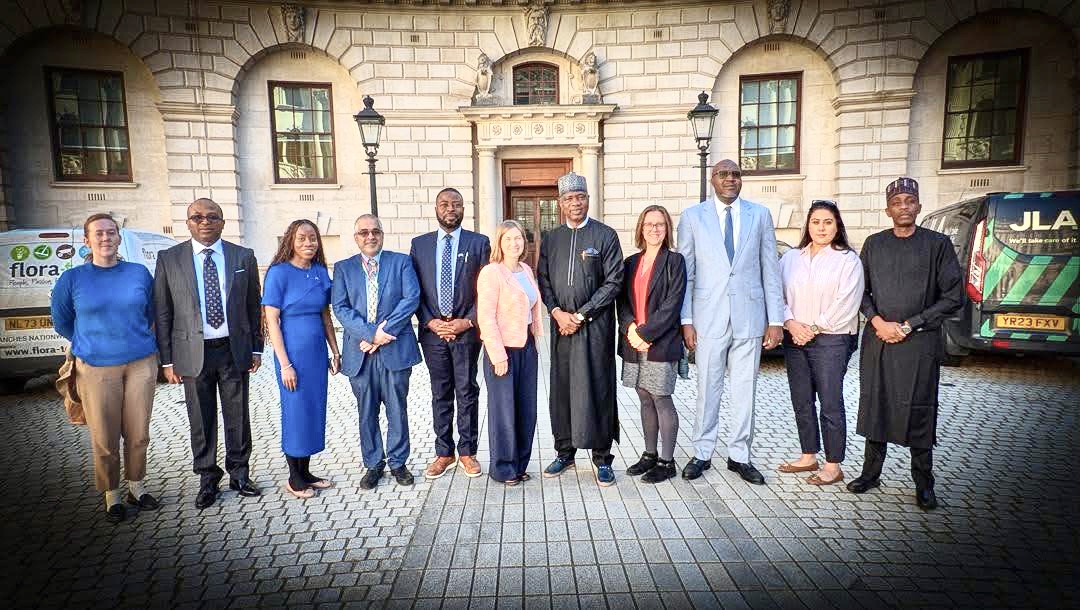
The Nigeria Customs Service In furtherance of its commitment for enhancing international cooperation and advancing trade facilitation, has strengthened its strategic engagement with His Majesty’s Revenue and Customs (HMRC) of the United Kingdom. This development followed a high-level bilateral meeting held in London on 18 March 2026 under the framework of the Nigeria–United Kingdom Enhanced Trade and Investment Partnership (ETIP).
The meeting was held on the sidelines of the State Visit of the President of the Federal Republic of Nigeria, His Excellency Bola Ahmed Tinubu, GCFR, to the United Kingdom.
The bilateral engagement, which centred on advancing customs modernisation, strengthening data transparency in trade flows, and expanding operational cooperation between both administrations, with a view to improving efficiency and integrity across the Nigeria–United Kingdom trade corridor, was led by the Comptroller-General of Nigeria Customs, Bashir Adewale Adeniyi, MFR, and Ms Megan Shaw, Head of International Customs and Border Engagement at HMRC.
The Comptroller-General emphasised that effective customs cooperation remains a critical enabler of economic growth and sustainable trade development. He noted that Nigeria and the United Kingdom share a long-standing economic relationship supported by active trade across key sectors, including industrial goods, agriculture, energy, and consumer products. He further stated that customs administrations serve as the frontline institutions responsible for ensuring that trade flows between both countries are transparent, secure, and mutually beneficial.
Both administrations acknowledged the existence of some gaps in bilateral trade data, identifying it as a structural issue requiring coordinated resolution.
Available statistics indicate that while approximately £504 million in UK-origin goods were recorded as imports into Nigeria in 2024, the United Kingdom reported exports to Nigeria valued at approximately £1.7 billion for the same period. To address this gap, both parties agreed to explore establishing a structured pre-arrival data exchange framework between their respective digital customs platforms to enhance risk management, improve data reconciliation, and strengthen compliance monitoring.
The engagement furthermore, provided an opportunity for both administrations to present their respective customs modernisation programmes, including the United Kingdom’s advancements in artificial intelligence-driven trade tools, digital verification systems, and real-time analytics capabilities.
The discussions underscored the importance of deeper collaboration in technology deployment and digital border management, while also producing key outcomes, including the development of a Customs Mutual Administrative Assistance Framework, the commencement of technical scoping for capacity-building and knowledge exchange, and the establishment of a joint technical engagement mechanism under the ETIP framework.
In advancing ETIP framework, the Customs reiterates its commitment to deepening international partnerships as part of its broader modernisation agenda to promote transparency, efficiency, and competitiveness in Nigeria’s trading environment. The Service also assures stakeholders that insights from this engagement will strengthen its operational capacity, enhance trade facilitation, and support Nigeria’s economic reform objectives under the Renewed Hope Agenda of President Tinubu.