Business and Maritime West Africa Analysis
The Federal Ministry of Marine and Blue Economy has presented an impressive scorecard of the reforms undertaken since its creation three years ago. At the centre of the presentation is the ₦1.83 trillion generated by agencies under the ministry in 2025, representing a 160 per cent increase over the ₦700.79 billion recorded in 2023.
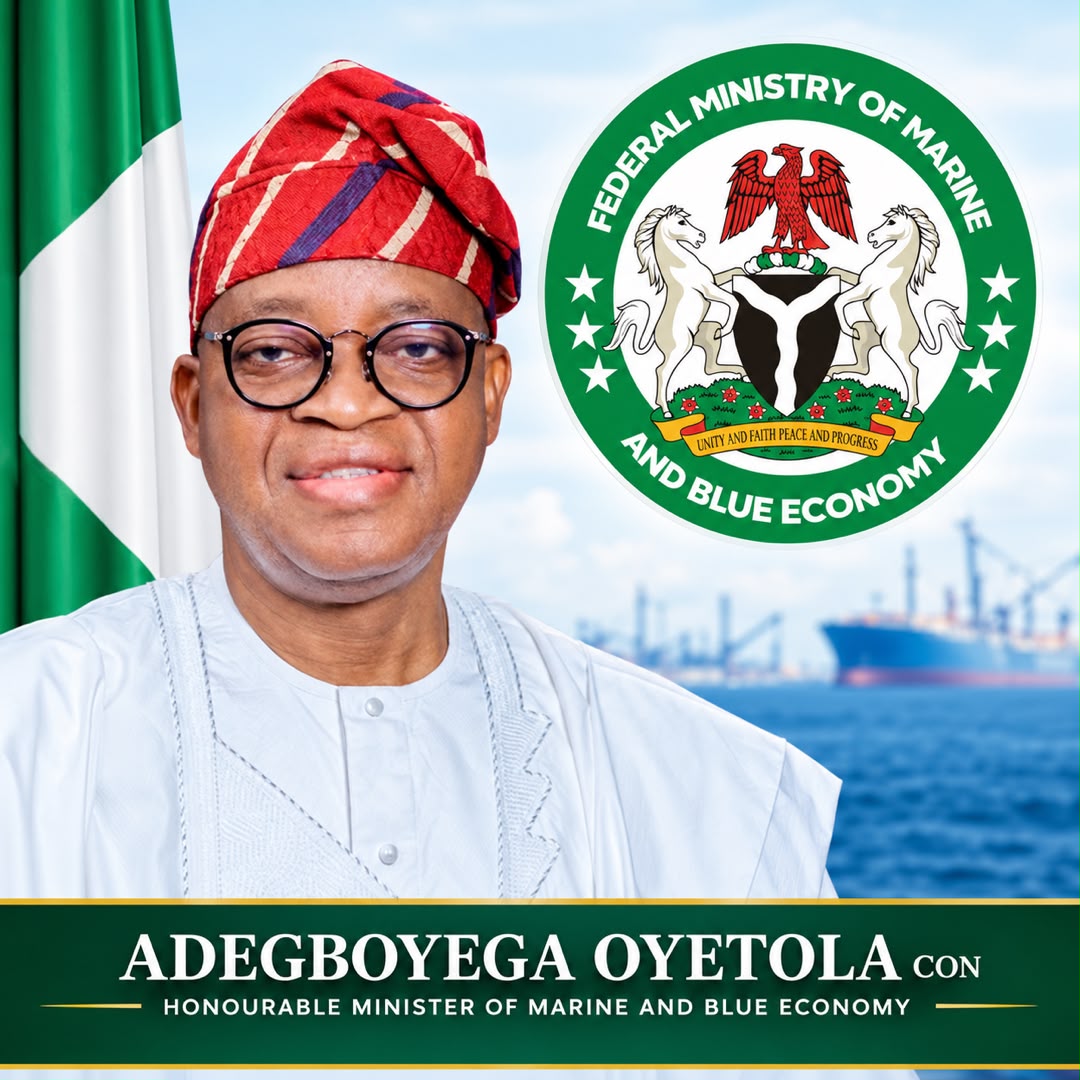
Minister of Marine and Blue Economy, Adegboyega Oyetola, attributed the increase to regulatory reforms, digitisation, improved revenue assurance and efforts to eliminate financial leakages. He also highlighted improvements in port infrastructure, maritime security, indigenous shipping, human-capital development, fisheries and inland-waterway safety. These are indeed achievements that deserve recognition.
Nigeria has returned to the International Maritime Organisation’s Category C Council after a 14-year absence. The country has maintained four consecutive years without a reported piracy incident in its territorial waters. Apapa and Tin Can Island ports have recorded significant improvements in international performance rankings. A National Policy on Marine and Blue Economy has been approved, while the Nigeria Ports Economic Regulatory Agency has emerged as a new economic regulator for the port sector.
The long-awaited process for accessing the Cabotage Vessel Financing Fund has also finally moved forward.
But a government scorecard should not be confused with the scorecard of an entire industry. That distinction is important because the ₦1.83 trillion represents revenue generated by government agencies. It does not, by itself, tell us how much wealth the Nigerian maritime economy created, how much remained in the country or how much reached Nigerian operators.
The more important question is therefore not simply how much government collected from the maritime sector, but whether Nigeria’s maritime economy has become substantially more competitive, productive and Nigerian-owned.
That is where the picture becomes more complicated. A maritime industry cannot be considered transformed merely because its regulators collect more revenue. The real indicators are the number and strength of Nigerian-owned vessels, the proportion of domestic cargo carried by Nigerian operators, the competitiveness of Nigerian ports, the cost and reliability of moving cargo, the availability of maritime finance, the growth of shipbuilding and repair, the employment of Nigerian seafarers and the ability of local businesses to capture a larger share of the maritime value chain.
By those measures, Nigeria has made progress, but much of the work remains unfinished.
The improvement recorded at Apapa and Tin Can Island ports is a good example. Their ranking among the world’s most improved container ports is significant. It shows that investments and operational reforms are producing results. But improvement from a weak starting point should not be mistaken for global competitiveness.
The continuing problems at the ports demonstrate the difference. In July 2026, about 1,000 export containers were reportedly awaiting shipment at Apapa following congestion and vessel-capacity challenges. The Nigerian Shippers’ Council had to intervene in the dispute between exporters and Maersk over delayed export containers.
For a country seeking to expand non-oil exports and take advantage of the African Continental Free Trade Area, this is more than an operational inconvenience. An exporter can produce a competitive product and still lose the international market if the cargo cannot reach the buyer on time.
This is why the ultimate measure of port reform cannot be how much infrastructure has been acquired or how much a port has improved in an international ranking. It must be how quickly, predictably and affordably cargo moves through the system.
Nigeria still has significant ground to cover.
Congestion has also become more complex. It is no longer simply the familiar queue of trucks outside Apapa. It encompasses vessel scheduling, berth availability, terminal capacity, cargo evacuation, road infrastructure, inland logistics, empty-container management and the costs associated with delays.
The fact that port users continue to face disputes over demurrage, detention and other charges shows that operational efficiency remains a work in progress.
The establishment of NPERA could eventually change this equation, but it is important not to claim for the new agency what it has not yet had sufficient time to deliver. Its real test will be whether port users experience more predictable tariffs, greater transparency, fairer competition and quicker resolution of commercial disputes.
The creation of an institution is the beginning of reform, not its conclusion. The same caution applies to indigenous shipping.
For more than two decades, Nigeria has had a Cabotage regime intended to promote Nigerian participation in coastal and inland shipping. The Cabotage Vessel Financing Fund was established to provide access to finance for indigenous shipowners. Yet Nigerian operators are still struggling to build the fleets required to take advantage of the law.
The movement of the CVFF process in 2026 is welcome. But it also highlights how long Nigeria has taken to address one of the fundamental weaknesses of its maritime economy.
The problem facing indigenous shipowners is not simply the absence of finance. Even when vessels can be financed, operators must find cargo, secure contracts, compete with better-capitalised foreign companies, maintain vessels, obtain insurance and navigate a complicated regulatory environment.
There is therefore a need to look beyond the CVFF. If Nigeria genuinely wants Nigerians to become owners rather than spectators in the maritime industry, financing must be accompanied by a coherent national fleet-development strategy.
That strategy must address access to cargo, Cabotage enforcement, local-content requirements, taxation, insurance, ship repair, shipbuilding and the continued use of foreign vessels in areas where Nigerian capacity should be developing.
This is particularly important because the persistence of foreign operators in domestic maritime activities continues to generate complaints from indigenous shipowners. The argument for foreign participation where local capacity does not exist is reasonable. But a temporary gap in Nigerian capacity should not become a permanent justification for dependence on foreign vessels.
A waiver should help create the conditions in which Nigerian capacity eventually replaces the waiver. Otherwise, Nigeria risks remaining trapped in a cycle in which local operators cannot build capacity because they lack contracts, while contracts continue to go elsewhere because local capacity is said to be inadequate.
That cycle must be broken if the blue economy is to produce genuine indigenous wealth. The proposed revival of a national shipping carrier must therefore be approached with similar caution.
Nigeria does need stronger national shipping capacity, but a commercially sustainable maritime industry cannot depend on a single government-backed carrier. The objective should be to create an ecosystem of competitive Nigerian-owned shipping companies supported by access to finance, predictable cargo, appropriate fiscal incentives and effective regulation. The country needs maritime champions, not simply another government-owned enterprise.
Where the present administration deserves particular credit is in maritime security.
Nigeria’s sustained absence of reported piracy incidents in its territorial waters is a significant achievement. The Deep Blue Project and collaboration between maritime and security agencies have strengthened the country’s security architecture and helped improve international confidence in Nigerian waters.
The country’s return to the IMO Council is also important because international maritime influence matters when decisions affecting shipping, safety and trade are being made.
But maritime security is broader than piracy.
The blue economy includes fishing communities, inland-waterway transport, coastal traders and small craft operators. Illegal fishing, attacks on fishermen, unsafe waterways, oil-related pollution and criminal activity affecting coastal communities cannot be ignored simply because the international piracy statistics have improved.
A commercial vessel sailing safely into Lagos is important. So is a fisherman being able to operate safely off the Nigerian coast.
The same broader perspective is required for fisheries. The reported increase in fish production to 1.4 million metric tonnes is encouraging, but Nigeria still falls well short of domestic demand. The country continues to depend on imports despite possessing extensive marine and inland-water resources.
The obstacles are familiar: high feed and input costs, expensive financing, inadequate cold-chain infrastructure, weak processing capacity, pollution and illegal fishing.
The blue economy cannot be reduced to extracting more economic value from the sea. It must also protect the resources from which that value is expected to come.
This is particularly important for Nigeria’s coastal and riverine communities, many of which depend directly on fisheries and waterways for their livelihoods. The country’s inland waterways present another example of the gap between potential and reality.
Nigeria has an extensive network capable of supporting passenger transportation, agricultural logistics and cargo movement. Yet recurring boat accidents demonstrate that infrastructure and safety standards remain inadequate in many areas.
Life jackets are necessary, but they are not a complete inland-waterway policy. Modern waterways require navigational aids, properly developed jetties, regulated vessels, trained operators, weather information, effective enforcement and search-and-rescue capacity.
The same applies to barging, which has been promoted as part of the solution to road congestion and port evacuation.
For barging to become a genuine alternative, indigenous operators must have predictable access to terminals and commercially viable charges. Complaints by local barge operators over access and rising costs indicate that the system still has shortcomings.
A blue economy cannot thrive on infrastructure that exists on paper but remains expensive or difficult for local businesses to use.
Digitalisation is equally important, but it must be judged by outcomes rather than technology itself. Nigeria’s ports and maritime agencies need integrated digital platforms. Electronic documentation, automated cargo processes, truck-call systems and the National Single Window can reduce human interference and improve transparency.
But digitising a process does not automatically make it efficient. The relevant question is whether traders now clear cargo faster, whether they submit the same information repeatedly to different agencies, whether physical examinations are reduced and whether the cost of doing business has fallen.
If an inefficient bureaucracy is simply transferred from paper to a computer, the country has digitised the problem rather than solved it.
Perhaps the most neglected component of Nigeria’s maritime ambitions is the industrial base supporting shipping.
A country cannot become a major maritime economy while depending heavily on foreign shipyards for vessel construction and major repairs.
Shipbuilding and ship repair have the potential to create thousands of skilled jobs and stimulate demand for steel fabrication, engineering, marine electronics, insurance, finance and specialised services. Every vessel built or repaired locally represents economic activity retained within the country.
This is where the blue economy should intersect with industrial policy. The objective should not simply be to have Nigerian vessels operating on Nigerian waters. Nigeria should gradually develop the industrial capacity to finance, build, repair, insure, crew and service those vessels domestically.
That would create a far deeper economic impact than regulatory revenue alone.
This brings the discussion back to the ₦1.83 trillion. The figure should be recognised for what it is: a substantial increase in revenue generated by maritime agencies and an indication that government revenue-assurance and collection systems have improved.
But it should not become the principal measure of the health of the maritime economy. There is a significant difference between maritime revenue and maritime wealth.
Revenue goes to government. Wealth is created across the economy. A genuinely successful maritime industry would see Nigerian shipowners carrying Nigerian cargo; Nigerian banks financing vessels; Nigerian insurers underwriting maritime risks; Nigerian shipyards building and repairing ships; Nigerian seafarers working aboard Nigerian vessels; exporters moving cargo efficiently through Nigerian ports; inland waterways providing safe and affordable transportation; and coastal communities earning sustainable livelihoods from marine resources.
Nigeria has pieces of this ecosystem, but they remain insufficiently developed and poorly integrated. The real scorecard should therefore move beyond agency collections and policy announcements.
It should measure how many Nigerian-owned vessels have actually been financed and are operating profitably. It should measure the share of domestic maritime cargo carried by Nigerian operators and whether dependence on foreign vessels is declining.
It should measure the time and cost required to move a container through Nigerian ports, the frequency of congestion-related disruptions, the incidence of disputed charges and the competitiveness of Nigerian ports against other West African gateways.
It should measure the number of Nigerians obtaining sea-time and permanent maritime employment, the growth of indigenous maritime companies, the development of shipyards and repair facilities and the contribution of fisheries and inland-water transport to local economies.
Above all, it should measure how much of Nigeria’s maritime value chain Nigerians actually control.
The Ministry of Marine and Blue Economy has succeeded in putting the sector firmly on the national economic agenda. That in itself is important.
The security gains are real. The port improvements are real. The return to the IMO Council is real. The national blue-economy policy is real. The regulatory reforms are real. The movement of the CVFF process is real.
But these achievements should be regarded as foundations rather than the finished structure.
Nigeria’s maritime industry remains burdened by inadequate indigenous fleet capacity, high financing costs, regulatory and operational bottlenecks, expensive logistics, infrastructure deficits, limited ship-repair and shipbuilding capacity, unresolved local-content concerns and the continuing difficulty faced by Nigerian operators in securing a larger share of maritime business.
The greatest danger now would be to confuse institutional activity with economic transformation.
Nigeria does not merely need maritime agencies that collect more revenue. It needs a maritime economy that creates more wealth. It needs Nigerian companies that can compete internationally. It needs Nigerian ships carrying Nigerian cargo. It needs efficient ports that serve exporters as well as importers. It needs safe and commercially viable inland waterways.
It needs productive and sustainable fisheries. It needs shipyards, maritime finance, insurance and marine technology. And it needs policies that move Nigerian operators from the margins of the maritime value chain to its centre.
The ₦1.83 trillion is therefore an important milestone, but it is not the final verdict on Nigeria’s blue economy.
The more important test is whether the revenue and reforms being celebrated today eventually translate into a maritime industry in which Nigeria does not merely regulate, tax and service maritime activity, but owns a substantial share of the wealth that the sea, the ports and the waterways generate.
That is the transformation Nigerians should ultimately demand.