 The recent ultimatum MWUN handed to the NPA over unpaid wages, if not promptly resolved may lead to labour unrest and add to the existing operational woes at the nation’s seaport, writes IZUCHUKWU OZOEMENA.
It is confrontation time at the ports. The bone of contention is alleged eight months unpaid salaries to over 2500 dockworkers engaged as tally clerks and onboard security men at all port formations nationwide. According to the Maritime Workers Union of Nigeria (MWUN) this debt has lingered over time.
The NPA, industry watchers have been told, has been foot-dragging on the resolution of this issue which is of critical concern to port operations. To resolve this, MWUN said NPA has been handed marching orders to comply within 14 days or risk labour unrest in the ports.
“Tally Clerks and Onboard Security men are dockworkers duly registered by Nigerian Maritime Administration and Safety Agency (NIMASA). Tally Clerks are statutorily empowered to perform the duty of tallying all import cargoes being discharged into our seaports, from ships and also tallying all export cargoes being loaded into ships in our seaports and terminals, on-shore and offshore. Similarly on-board security men are also statutorily empowered to provide security onboard ships.
The wages of Tally Clerks and Onboard Security men are paid by the Nigerian Ports Authority, through the Stevedoring Contractors. Payment of their wages in the past “was promptly made as and when due until a few but highly influential persons in connivance and collaboration with past and present management personnel of NPA created a body known as Cargo Surveyors to unjustly take over the statutory functions of the Tally Clerks and Onboard security men,” said the MWUN President-General, Anthony Emmanuel Nted.
He said this while drawing public attention to the woes of his members and steps the union would take if their demands were not met within a specified period. He recalled several meetings held in the past by his union and the NPA management on the issue which yielded no result, threatening that this time around, the matter would take a different dimension.
According to the maritime labour union, NPA diverted the dockworkers’ wages to the payment of cargo surveyors. “NPA pays this body millions of Naira monthly to the neglect of the tally clerks and onboard security men whose services are prepaid for to NPA by the cargo owners/shipping agents.” In her resolve to reach a peaceful settlement of the issue, Nted recalled, his union met severally with the NPA management, the Federal Ministry of Labour and Productivity and the Ministry of Transport after which promises were made and a memorandum of understanding crafted, but all to no avail. Maintaining that tally clerks and onboard security men cannot be “unjustly substituted with cargo surveyors,” MWUN insisted that cargo surveyors should be withdrawn from all seaports without further delay.
In her reaction through an advertorial, NPA sued for restraint to ensure industrial peace and harmony in the nation’s seaports. It recalled her request last December to all employees of tally clerks and on-board security men with ongoing contractual relationship with the Authority to embark on a verification exercise to enable prompt settlement of outstanding sums. The verification, NPA reasons, is necessary so as to “authenticate all payment claims from contractors and to justify the enormity of financial burden” on the organization. The Authority explained that her inability to process payment so far was hinged on the fact that no employer had responded to the December notice. At no point, it said, had the Authority been the employer of dockworkers. “Prior to the 2005 port reform, the Authority ran a full service port system and was directly involved in cargo receipt from the vessel, its discharge and subsequent delivery to the consignee”. She argued that following ports concession, cargo operations became the responsibility of the terminal operators who are now the master stevedores for their individual terminals, with the authority to hire dock labour employees for supply of dock workers to their terminal and to pay them accordingly.
Following the port reform and agitation by the dockworkers’ union, government approved a severance package of N200, 000 which was paid by the Authority to each of the dockworkers severed on account of age or low productivity while the Nigerian Maritime Administration and Safety Agency (NIMASA) ultimately took over the responsibility of registration, welfare, training and regulation of dock labour practice in the country. The NPA informed that she has been responsible for stevedoring contractors who engage dockworkers operating at jetties under her supervision. She attested to the fact that payment to these contractors has been consistent, and reiterated her appeal to all employers of tally clerks and onboard security men with existing contractual relationship with her to verify their status so as to facilitate the payment process.
STAKEHOLDERS WORRY
As what appears as an unnecessary controversy rages between the NPA and MWUN over this issue, maritime stakeholders call for a quick and easy resolution in order not to worsen the hopeless operational environment Nigerian seaports are witnessing presently. Speaking to BMWA in Lagos on the sidelines of the 2015 Nigerian Maritime Expo (NIMAREX), stakeholders roundly blamed the NPA for allowing a simple matter that ought to have been settled to degenerate. A master mariner who chose to remain anonymous said presently, the ports are grappling with many problems, mostly man-made. Adding another and a more devastating one to these would sound a death knell to port operations in Nigeria. “Allowing the maritime workers’ ultimatum to lapse with the issue at stake unresolved is dangerous because their threat to ground the ports is real.
For years, especially since NPA leased the ports to private terminal operators (PTOs), things have not been the same. Ports operations have been dogged by a myriad of problems. It is true that following investments in modern technology by the PTOs as exemplified in new plants and infrastructure, turnaround time of vessels has increased, among other strides. But the fact remains that port operations are dogged by a myriad of problems which are contributing to make it impossible for Nigeria to achieve the lofty objectives of the concession regime.
There has been a consistent report of extortion of port users by security agents and other government agencies in the ports. Prominent among these is the issue of alleged extortion often leveled against police officers and NPA security operatives at the nation’s seaports. The case of Lagos ports is outstanding. This prompted a meeting in Abuja, early July, between a maritime industry group, the Save Nigeria Freight Forwarders, Importers and Exporters Coalition (SNFFIEC) and Mr. Solomon Arase, the Inspector-General of Police. Giving an insight into reasons for the meeting, SNFFIEC’s arrowhead, Patrick Osita Chukwu regretted that extortion at the ports lead to extra cost of doing business, a burden that is usually transferred to the final consumers of imported products. Chukwu recalled that members of the association and other freight forwarders have been paying unnecessary demurrage at the ports due to delay in the release of containers arising from undue interference in the cargo clearing process by security agents. The Abuja meeting with the IGP, he revealed, was the fallout of a petition in this regard to the highest authorities.
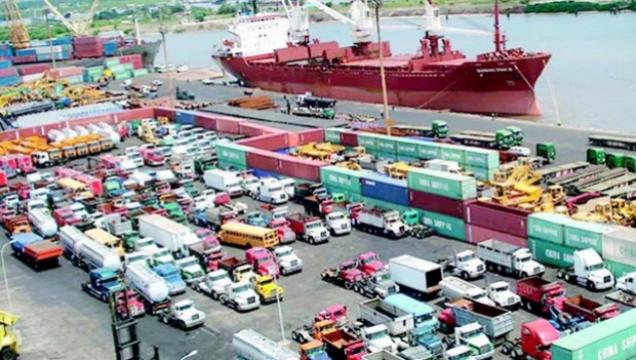
It is no longer news that for a number of reasons, access to and from the ports in Lagos is now nightmarish. Traffic gridlock is now part and parcel of the Apapa locale as container-laden trucks and tankers occupy the roads on a permanent basis. A number of measures put in place in the past by the Lagos government and federal authorities to solve the nagging problem have, at best, been mere palliatives. The measures often turned out a mere flash in the pan as the trucks always came out more in their numbers as if to dare the authorities.
On assumption of duty last May as Lagos State governor, Mr Akinwunmi Ambode set up a task force saddled with the responsibility of keeping trucks and tankers off the Apapa/Oshodi expressway so that movement within the port town can be restored. The task force went to work and restored sanity on the route for only two weeks. Thereafter, in what observers describe as an affront on the new governor, the trucks have returned to the road, completely taking over whatever lane they had previously left for other road users.
Meanwhile, the roads are still riddled with potholes and craters into which trucks and containers they carry fall at the slightest jerk.
Of course, these and other challenges have contributed to impede operations in the ports. While these problems are begging for solution, industry watchers say, any form of labour dispute and strike will obviously compound the situation. Early resolution saves the evil day.