
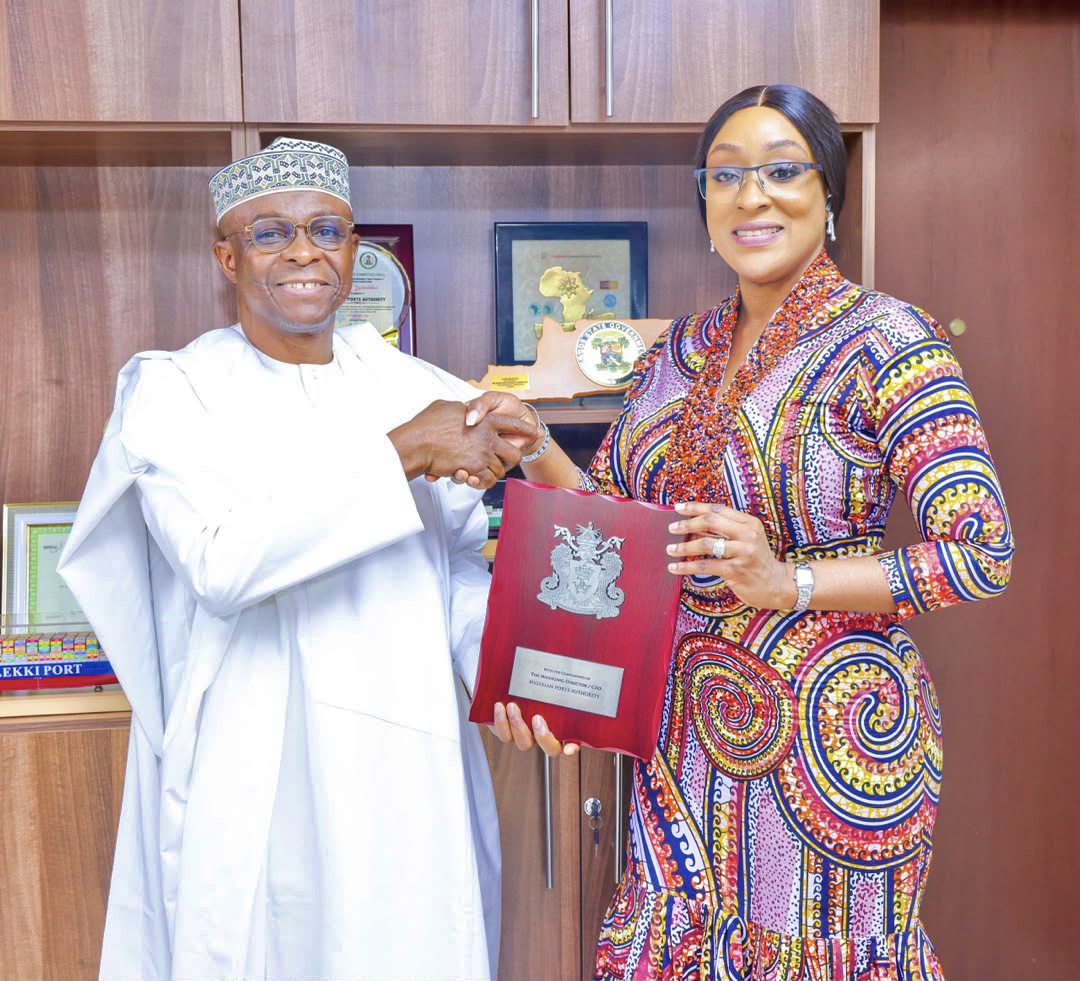
The Managing Director of NPA, Engr. Abubakar Dantsoho and Managing Director of NDPHC, Engr. Jennifer Adighije exchanging handshakes.
The Nigerian Ports Authority (NPA) has facilitated the recovery and clearance of several consignments of critical power equipment belonging to the Niger Delta Power Holding Company Limited (NDPHC) that had remained abandoned at various Nigerian seaports.
The intervention is expected to help the company deploy the equipment for ongoing power infrastructure projects, while averting potential financial losses running into billions of naira.
The NDPHC Managing Director and Chief Executive Officer, Engr. Jennifer Adighije, disclosed this on Friday, when she led the company’s management team on a courtesy visit to the NPA Managing Director, Dr. Abubakar Dantsoho, and his management team at the Authority’s headquarters in Marina, Lagos.
Adighije commended the NPA for intervening in the matter, saying the recovery of the cargoes would help remove a major logistical obstacle to the implementation of projects critical to Nigeria’s electricity infrastructure.
According to her, the equipment was required for NDPHC projects and prolonged delays in recovering and clearing the consignments could have translated into additional costs, disrupted project schedules and delayed the delivery of infrastructure designed to improve electricity supply.
She said the NPA intervention had prevented significant financial losses and saved the company several billions of naira that could otherwise have been lost.
The development highlights the often-overlooked connection between Nigeria’s ports and the delivery of critical national infrastructure. For projects that depend on imported turbines, transformers, transmission equipment, switchgear and other specialised components, delays at the ports can extend beyond storage and demurrage costs. They can also hold up construction, installation and commissioning schedules.
For the power sector, such delays can have wider economic consequences because the value of equipment is ultimately tied to the infrastructure it is intended to complete. A transformer or other specialised component lying idle at a port cannot contribute to generation, transmission or distribution capacity until it reaches the project site.
NDPHC was established as the corporate vehicle for the Federal, State and Local Governments to implement the National Integrated Power Projects (NIPP), a programme conceived in 2004 to rapidly expand Nigeria’s electricity infrastructure. Its mandate covers critical investments across generation, transmission and distribution.
The company currently manages a portfolio of major generation assets, including the Alaoji, Olorunsogo, Calabar, Omoku, Omotosho, Gbarain, Ihovbor, Egbema and other NIPP power plants. Its activities also extend to transmission and distribution infrastructure intended to improve the evacuation and delivery of electricity.
Against this background, Adighije stressed the need for stronger coordination between agencies operating across the maritime and energy sectors.
She called for sustained collaboration between NDPHC, NPA and other relevant government agencies to prevent bureaucratic and logistical bottlenecks capable of delaying the movement of equipment needed for critical infrastructure projects.
She said timely clearance was particularly important because contractors and project teams needed unhindered access to materials in order to execute projects within schedule.
Adighije added that the visit was also intended to strengthen the strategic relationship between NDPHC and NPA and deepen cooperation in areas of mutual interest.
She expressed appreciation to Dantsoho and the NPA management for their support and commitment to resolving issues affecting the movement of NDPHC equipment through the nation’s ports.
She assured the Authority that NDPHC remained committed to strengthening the relationship in the interest of the power sector and national development.
The NDPHC delegation included the Executive Director, Corporate Services, Hon. Chukwuma Umeoji; Executive Director, Finance and Accounts, Mr. Omololu Agoro; and Head, Expediting and Logistics, Rufai Ahmed. (Energy Focus Report)
Responding, Dantsoho commended the NDPHC management for the visit and reaffirmed the NPA’s readiness to support partnerships capable of advancing national development.
He congratulated the company on its contribution to Nigeria’s power sector, stressing the importance of efficient and reliable electricity to economic growth, industrialisation and improved living standards.
Dantsoho assured the delegation that the NPA would remain open to meaningful engagement with NDPHC and other strategic stakeholders whose activities contribute to the growth of the national economy.
He further assured the company of the Authority’s continued support for initiatives aimed at facilitating the movement and clearance of critical equipment, particularly consignments destined for projects capable of strengthening Nigeria’s infrastructure.
The intervention also underscores the broader economic importance of efficient port logistics. As Nigeria seeks to expand electricity supply and improve the reliability of its power infrastructure, the ability to move specialised equipment through the ports and onward to project locations becomes an important part of the infrastructure delivery chain.
The NDPHC-NPA engagement therefore goes beyond the recovery of stranded cargoes. It points to the need for closer coordination between agencies whose mandates intersect whenever major infrastructure projects depend on imported materials.
With NDPHC responsible for implementing major national power projects and the NPA serving as a key facilitator of maritime trade and cargo movement, sustained cooperation between the two institutions could help reduce delays, contain avoidable costs and ensure that equipment procured for public infrastructure delivers its intended economic value.
The immediate outcome, according to NDPHC, is the recovery of valuable equipment and the prevention of billions of naira in potential losses. The larger objective is to ensure that cargoes brought into Nigeria to strengthen electricity infrastructure do not become stranded assets at the ports, but are moved quickly enough to become productive assets powering the country’s economic development